
How Experience Points Work in Text RPGs

Experience points (XP) in text RPGs are numerical rewards earned by completing objectives, overcoming challenges, and role-playing, which characters use to level up and improve their stats and abilities. Understanding how experience points work in text RPGs separates players who grind aimlessly from those who build characters with purpose. Systems range from the simple fixed-threshold models found in tabletop-inspired games to the layered point-buy mechanics of titles like Kingdom of Loathing (KoL) and Baldur’s Gate 3 (BG3). Each approach shapes how fast you grow, what you can customize, and how much your decisions actually matter.
How is experience earned and calculated in text rpgs?
Experience points are awarded for completing objectives, overcoming obstacles and opponents, and successful role-playing. That covers a wide range of in-game actions, from defeating enemies in combat to talking your way out of a confrontation or finishing a side quest. The key insight is that XP is not just a combat reward. It is a measure of meaningful engagement with the game world.
Fixed vs. scalable XP awards
Fixed XP awards give the same reward every time you complete a specific action, regardless of your current level. Scalable systems adjust the reward based on the difficulty gap between you and the challenge. Fixed systems are easier to design and predict. Scalable systems keep every encounter feeling relevant, even after you have leveled up significantly.
Quest XP in BG3 works differently than most players expect. Quest XP is granted per sub-step rather than on overall completion, with the exact amounts hidden from the player. This means you earn XP as you progress through a quest, not just when you hand it in. That design choice keeps momentum going and rewards exploration rather than rushing to the finish line.
How the XP accrual loop works
Most text RPGs use a “bank and threshold” model. Your character accumulates XP in a running total, and the game checks that total against a threshold after every action that awards points. One reference text RPG implementation levels up whenever XP reaches 100 points, subtracts 100, and repeats the check in a loop to handle multiple level-ups from a single large gain. That loop prevents progression drift, where a player earns 350 XP at once but only levels up once instead of three times.
- Combat XP: Awarded for defeating or neutralizing enemies
- Quest step XP: Granted at each objective milestone, not just completion
- Role-play XP: Earned through dialogue choices, persuasion, and character-consistent decisions
- Exploration XP: Some systems reward discovering new locations or triggering hidden events
- Non-combat resolutions: BG3 rewards peaceful outcomes, but killing after peaceful resolution grants zero additional XP
Pro Tip: Track which quest steps award XP in your current playthrough. In games like BG3, you can earn more total XP by completing every sub-objective than by rushing to the final goal.
What are the common XP progression systems in text rpgs?
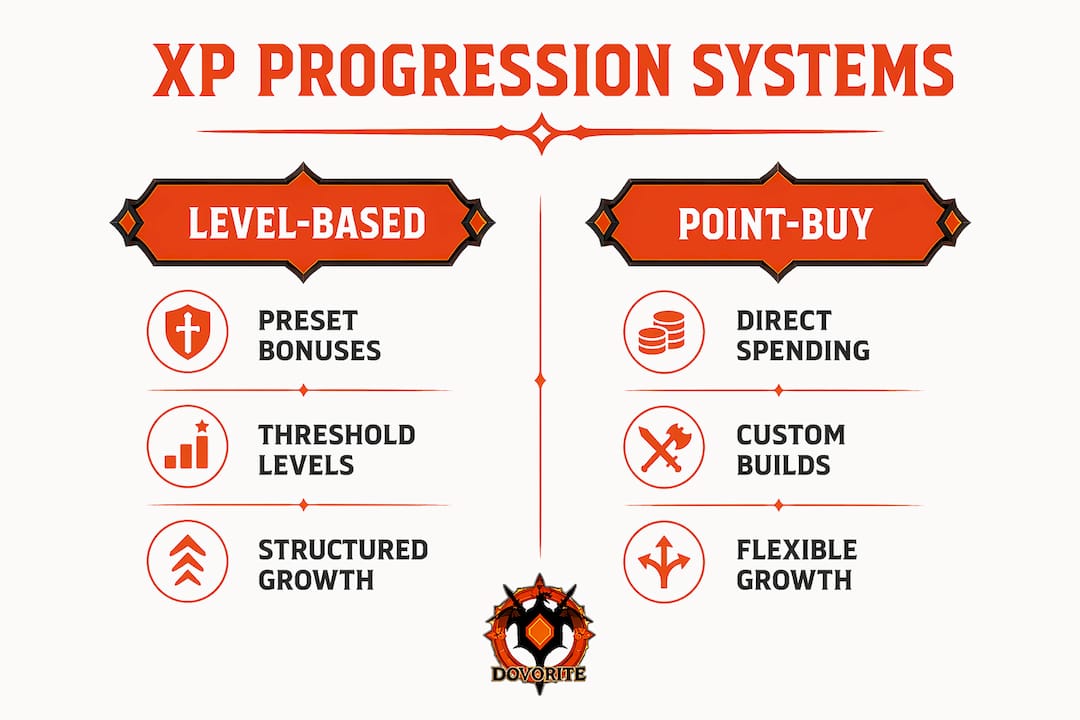
Two models dominate text RPG design: level-based threshold systems and point-buy systems. Each produces a fundamentally different gameplay experience, and understanding the tradeoff helps you choose the right approach for your playstyle.
Level-based threshold systems
A level-based XP loop works like this: accumulate XP, hit a threshold, gain preset level bonuses, apply changes to your character sheet, and recalculate derived stats. D&D’s progression model is the most recognized example. Every level-up delivers a defined package of improvements, which makes the system predictable and easy to follow. The tradeoff is that you have little control over what you gain. The game decides your bonuses.

Point-buy systems
Point-buy systems convert earned XP directly into character points that you spend on specific stats and skills. KoL uses this model. The XP cost to raise a stat equals 2n + 1, where n is the stat’s current score. That formula means raising a stat from 10 to 11 costs 21 XP, but raising it from 20 to 21 costs 41 XP. The cost scales with your current score, which pushes players to invest early and broadly rather than stacking one stat to extremes.
| Feature | Level-Based | Point-Buy |
|---|---|---|
| Progression style | Preset bonuses at each level | Spend XP on chosen stats and skills |
| Customization | Low to moderate | High |
| Predictability | High | Moderate |
| Complexity | Low | Moderate to high |
| Example games | D&D, most classic text RPGs | Kingdom of Loathing (KoL) |
| Best for | New players, narrative focus | Strategy-focused players |
The tradeoff between preset level bonuses and point-buy customization explains why some text RPGs feel approachable and others feel like spreadsheets. Neither model is superior. They serve different player goals.
Pro Tip: If you are playing a point-buy system for the first time, invest in your primary stat early. The cost formula in games like KoL means early investment is far cheaper than trying to catch up later.
How do XP thresholds and scaling curves affect leveling pace?
XP thresholds do not stay flat. XP requirements increase based on base XP and multiplier parameters as an exponential level curve. That means each new level costs more XP than the last. The steepness of that curve is one of the most powerful design levers a text RPG creator has.
Here is how scaling curves shape your experience as a player:
- Shallow curves keep leveling fast and frequent, which feels rewarding but can make the game feel too easy too quickly.
- Steep exponential curves slow progression significantly at higher levels, forcing players to engage with more content before advancing.
- Polynomial curves offer a middle ground, scaling gradually rather than spiking sharply at high levels.
- Flat thresholds (like the 100 XP per level example) are common in simpler text RPGs and work well for short-form or educational games.
- Hybrid models combine a flat early curve with exponential scaling at higher levels, easing new players in while challenging veterans.
Understanding the curve in your current game changes how you plan. If you know the XP cost doubles every five levels, you will prioritize high-yield quests and encounters before pushing into harder territory. Handling large single XP gains requires looping level checks to prevent progression drift and lost XP. A well-designed system never wastes the points you earn.
How is XP distributed across stats and party members?
Earning XP is only half the equation. How that XP translates into actual character growth determines your long-term power and flexibility. Two distribution questions matter most: how XP splits across stats, and how it shares across a party.
Stat distribution and RNG
KoL’s stat allocation is a clear example of how distribution ratios shape character identity. Battle-derived stat points distribute in a 2:1:1 ratio between primary, secondary, and tertiary stats, with RNG making the exact split uneven in any given session. That ratio shifted from 3:2:2 in 2005 to the current 2:1:1, which tightened the gap between primary and secondary stat growth. The practical effect is that your primary stat grows roughly twice as fast as your others, reinforcing class identity without locking you out of secondary development.
You can read more about how these ratios affect gameplay in Dovorite’s breakdown of stats in text RPGs.
Party XP sharing
Party-based text RPGs add another layer. In BG3, XP is awarded to interacting creatures and nearby allies once per encounter, which means the whole party benefits from a single interaction. This design prevents the “kill-stealing” problem where one character hogs all the growth. It also means your companion builds stay competitive without requiring you to micromanage who lands the finishing blow.
- Shared XP pools keep all party members at similar levels, reducing the risk of one character falling behind
- Individual XP tracks reward active players but can create power gaps in multiplayer or companion-heavy games
- Non-combat XP from dialogue and exploration often distributes to the whole party, rewarding creative play
- Background goals in some systems award bonus XP for character-consistent choices, adding a role-play incentive on top of combat rewards
XP distribution and scaling shapes player behavior more than raw XP numbers do. The ratio and sharing rules guide where you focus your energy, which quests you prioritize, and how you build your party. Understanding this turns XP from a passive reward into a strategic resource.
For a deeper look at how companion systems handle shared progression, Dovorite’s guide on companion XP management covers the mechanics in detail.
Key takeaways
XP in text RPGs is a strategic resource, not just a score, and how you earn and spend it determines the kind of character you build.
| Point | Details |
|---|---|
| XP sources vary widely | Combat, quest steps, role-play, and exploration all award XP depending on the game’s design. |
| Two main progression models | Level-based systems offer predictability; point-buy systems offer customization at increasing cost. |
| Scaling curves control pacing | Exponential or polynomial XP thresholds slow progression at higher levels to maintain challenge. |
| Stat distribution shapes identity | Games like KoL use fixed ratios (2:1:1) to reinforce class roles while allowing secondary growth. |
| Party sharing prevents power gaps | Shared XP pools in games like BG3 keep companions competitive without micromanagement. |
Why most players misread their XP systems
Most players treat XP as a passive reward. They fight, they earn, they level up, and they move on. That approach works, but it leaves a lot of character potential on the table.
The most common misconception I see is that all XP is equal. It is not. In a point-buy system like KoL, 100 XP spent on a stat at score 5 buys you far more growth than 100 XP spent at score 15. The cost formula punishes late investment. Players who understand this front-load their primary stat investment in early levels and diversify later, when the marginal cost of each point is lower relative to their total XP income.
The level-based vs. point-buy debate also gets oversimplified. People assume level-based systems are for casual players and point-buy is for min-maxers. The reality is more nuanced. Level-based systems with well-designed preset bonuses can produce deeply satisfying character arcs. Point-buy systems can feel paralyzing if the cost curves are not communicated clearly. The best text RPGs, regardless of model, make the XP rules transparent and let players make informed choices.
My honest recommendation: read the XP rules before you start, not after you hit a wall at level 10. Knowing whether your game uses exponential scaling or a flat threshold changes how you approach the first five hours completely.
— Corban
Experience XP mechanics firsthand on Dovorite
Dovorite brings these XP mechanics to life inside fully playable narrative RPGs where every choice you make shapes your character’s growth. The platform’s stories integrate XP-driven progression directly into the storytelling, so leveling up feels like a natural consequence of the decisions you make, not a background number ticking upward.

Whether you prefer the structured advancement of a level-based system or the strategic depth of point-buy character building, Dovorite’s adventures put those mechanics in your hands. Start with The Last Dragon’s Hoard for a rich introduction to XP-based character advancement inside a fully realized fantasy world. Or explore the full catalog at Dovorite Chronicles to find the adventure that matches your playstyle. Don’t just read about XP systems. Play them.
FAQ
What are experience points in a text RPG?
Experience points are numerical rewards earned by completing objectives, defeating enemies, and role-playing. They accumulate until a threshold is reached, triggering a level-up that improves stats and unlocks abilities.
How do you gain XP faster in text rpgs?
Focus on quest sub-steps, non-combat resolutions, and exploration events, since many games award XP at each objective milestone rather than only on final completion. Prioritizing high-yield encounters early in a scaling curve also maximizes your return.
What is the difference between level-based and point-buy XP systems?
Level-based systems grant preset bonuses when you hit a threshold, while point-buy systems let you spend XP directly on chosen stats at increasing costs. Level-based systems are more predictable; point-buy systems offer more customization.
How does XP sharing work in party-based text rpgs?
In games like BG3, XP is awarded to all nearby party members once per encounter, preventing any single character from monopolizing growth. Killing an enemy after a peaceful resolution grants no additional XP.
Why do XP requirements increase at higher levels?
Most text RPGs use exponential or polynomial scaling curves, where each new level costs more XP than the last. This slows progression at higher levels to maintain challenge and extend meaningful gameplay.