How Multiplayer RPG Narratives Evolve in 2026
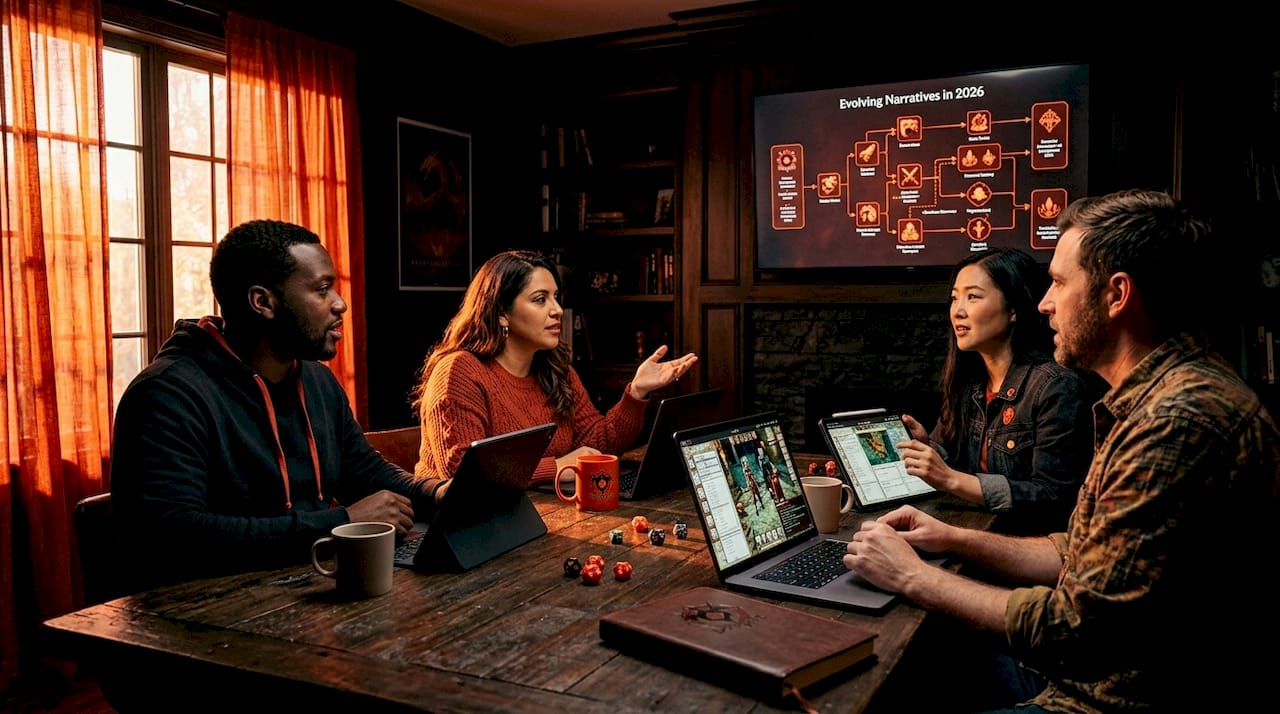
Multiplayer RPG narrative evolution is defined by the shift from isolated, solo storylines to persistent, player-shaped shared histories that grow across every session. Games like No Rest for the Wicked and Tides of Tomorrow demonstrate that the most engaging multiplayer experiences now treat the story itself as a living world state, not a backdrop. Technologies including AI-driven NPC dialogue, asynchronous player impact systems, and schema-governed generation pipelines are the actual mechanisms behind this shift. Understanding how these systems work tells you exactly why multiplayer stories feel different from anything a single-player campaign delivers.
How multiplayer RPG narratives evolve through persistent shared worlds
The defining feature of modern multiplayer RPG narrative design is what developers call stateful persistence: the world remembers what players did, and every new session inherits those consequences. This is a fundamental break from traditional co-op, where players shared a screen but not a history.
No Rest for the Wicked creates persistent realms where the consequences of player decisions remain visible across sessions, making shared decision-making a structural pillar of the game rather than an optional feature. A faction you weakened last Tuesday is still weakened when your friend logs in on Friday. That continuity transforms narrative from something you consume into something you author collectively.
The implications for storytelling are significant. When world states accumulate, individual events stop feeling disposable. They become lore. Persistent realms with re-entrant consequences enable story accumulation into meaningful lore rather than isolated plot moments, which is precisely why players in these games develop genuine attachment to their server’s history. You are not just playing a story. You are writing one that outlasts your session.
Key design features that enable this kind of narrative persistence include:
- World-history layering: Each session appends to a shared record rather than resetting it
- Consequence re-entrance: Returning players encounter the downstream effects of prior group decisions
- Realm-level visibility: All players in a shared realm can observe and react to the same narrative changes
- Durable NPC states: Characters remember prior interactions and shift behavior accordingly
Pro Tip: If you want your multiplayer group to feel genuinely invested in a shared story, choose games that track world-state changes between sessions. The moment players realize their past choices still matter, narrative engagement increases sharply.
What is asynchronous multiplayer and how does it reshape RPG storytelling?
Asynchronous multiplayer in narrative RPGs means that players do not need to be online simultaneously to influence each other’s stories. One player’s choices alter the world state that the next player inherits, creating a layered, evolving narrative without requiring real-time coordination.
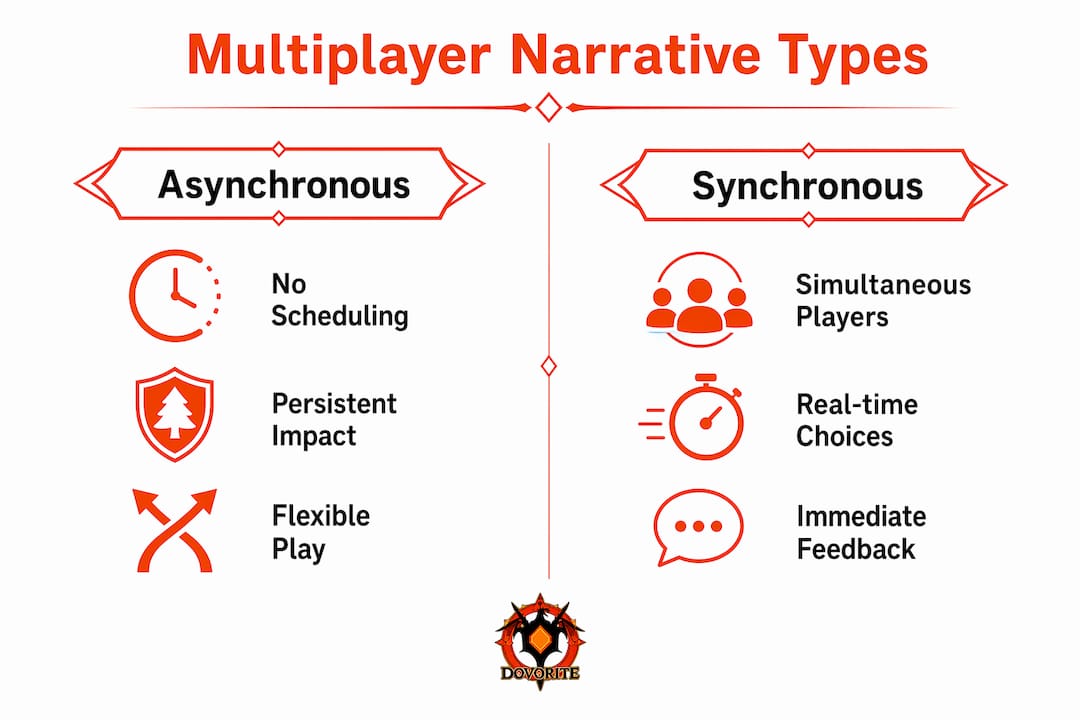
Tides of Tomorrow is the clearest current example of this design philosophy. Players’ previous actions alter NPC states, merchant stock, and route availability for subsequent players, blending single-player narrative pacing with genuine multiplayer impact. You might arrive at a village to find a merchant gone because another player’s earlier choice drove them away. That absence is a story beat you did not script but must now navigate.
This approach solves one of the hardest problems in multiplayer narrative game mechanics: scheduling. Traditional co-op requires everyone to be present for the story to advance. Asynchronous systems let the narrative evolve continuously, with each player contributing a layer even when playing alone.
Here is how asynchronous narrative mechanics compare to synchronous co-op storytelling:
| Feature | Asynchronous multiplayer | Synchronous co-op |
|---|---|---|
| Scheduling requirement | None. Play when available | All players must be online together |
| Narrative continuity | Inherited world state from prior players | Shared real-time experience |
| Story divergence | High. Each session builds on different prior states | Low. All players experience the same moment |
| Replay value | High. World shifts between each playthrough | Moderate. Replay requires group coordination |
| Emotional ownership | Personal. Your choices leave a lasting mark | Collective. Group decisions drive the story |
The challenge asynchronous design introduces is perceived coherence. If the world changes too dramatically between sessions, players can feel disoriented rather than engaged. The solution most studios use is constraining the range of change: merchant stock shifts, but the town itself does not disappear. Route availability changes, but the map stays readable. Multiplayer text adventures that handle this balance well tend to generate the strongest long-term communities.
Pro Tip: When designing or evaluating asynchronous narrative systems, test whether a new player can understand the current world state within five minutes. If they cannot, the system is accumulating drift faster than it is generating meaning.
How AI and large language models are changing NPC dialogue in RPGs
AI-driven NPC interaction is the technology most responsible for making multiplayer RPG storytelling feel genuinely responsive rather than scripted. Large language models allow NPCs to generate contextually appropriate dialogue on demand, but the engineering constraints behind this are more complex than most players realize.
Systems target under 500ms NPC response latency using smaller, faster models combined with relevance-scored memory stores to maintain personality consistency. That half-second ceiling is not arbitrary. Anything slower breaks conversational immersion, which is the exact quality these systems are designed to create. The memory component is equally critical: without it, an NPC forgets your prior conversation the moment a new one starts.
Questsmith’s approach to this problem is instructive. Persistent memory tracks character decisions, relationships, and world states to prevent breaks in narrative continuity across multiple play sessions. Rather than relying on raw conversation logs, which grow too long for efficient retrieval, Questsmith extracts and stores only the most narratively significant details. The NPC does not remember every word you said. It remembers that you betrayed the guild, and it behaves accordingly.
The engineering techniques that make this work at scale include:
- Memory extraction: Distilling long conversations into compact, retrievable narrative facts
- Conversation windowing: Keeping only the most recent and most relevant exchanges in active context
- Relevance scoring: Prioritizing memories that affect current NPC behavior over peripheral details
- Prompt engineering: Structuring inputs so the model generates responses consistent with established character personality
A critical design distinction separates two types of persistence that must be handled differently:
| Persistence type | Examples | Error tolerance |
|---|---|---|
| Game state (hard) | Health, inventory, quest flags | Zero. Errors cause bugs and break gameplay |
| Narrative flavor (soft) | NPC tone, relationship warmth, recalled details | Low. Small errors are acceptable if rare |
Mixing these two persistence types without separate handling is a common source of immersion-breaking errors in AI-assisted RPGs. A health value that resets is a game-breaking bug. An NPC who slightly misremembers your name is a minor inconsistency. Treating them identically in the persistence layer creates unnecessary fragility.
What narrative management systems keep multiplayer RPG stories coherent?
Generating dynamic narrative in a multiplayer RPG is one problem. Keeping that narrative coherent across dozens of concurrent players, sessions, and AI-generated story branches is a different and harder problem. Structured knowledge management systems exist specifically to solve it.
The G-KMS framework (Game Knowledge Management System) addresses this directly. Schema-governed generation and normalization-based repair produce stable, engine-executable narratives with high player-perceived quality. The schema acts as a contract: any narrative element the AI generates must conform to the game world’s established rules before it enters the live game state. If it does not conform, the normalization layer repairs or rejects it.
This matters because the alternative is stochastic divergence. Without schema constraints, AI-generated narrative drifts. An NPC might reference a location that does not exist, or a plot event might contradict established lore. In a single-player game, these errors are annoying. In a multiplayer RPG where dozens of players share the same world state, they are corrosive to the entire narrative structure.
The components of a reliable narrative management pipeline include:
- Engine-aligned knowledge admission: Only narrative facts compatible with the game engine’s current state enter the knowledge base
- Playability probes: Automated checks that verify generated story elements can actually be executed in the game world
- Plot sequence alignment: Narrative beats are ordered and constrained to prevent logical contradictions
- Normalization repair: Malformed or inconsistent narrative outputs are corrected before reaching players
Long-horizon narrative coherence in multiplayer AI pipelines benefits from schema-governed memory and alignment of narrative beats that constrain stochastic text generation. This is the technical reason why some AI-assisted RPGs feel like they have a consistent authorial voice while others feel random. The difference is not model quality alone. It is architecture. Exploring AI storytelling mechanics in depth reveals how much of what players experience as “good writing” is actually good systems design.
Pro Tip: For storytellers building narrative systems, treat your world’s lore as a schema first and a story second. Every narrative element should be validatable against your world’s rules before it reaches the player.
Key takeaways
Multiplayer RPG narratives evolve through persistent world states, asynchronous player impact, AI-driven NPC memory, and schema-governed generation pipelines working together to transform shared play into shared authorship.
| Point | Details |
|---|---|
| Persistent realms define modern RPG narrative | Games like No Rest for the Wicked make shared decision-making a structural pillar, not a feature. |
| Asynchronous multiplayer expands narrative reach | Tides of Tomorrow proves players can shape each other’s stories without ever being online at the same time. |
| AI memory architecture drives NPC coherence | Systems like Questsmith use memory extraction and relevance scoring to keep NPCs narratively consistent across sessions. |
| Separate hard and soft persistence | Game state and narrative flavor require distinct persistence approaches to prevent immersion-breaking bugs. |
| Schema governance prevents narrative drift | G-KMS-style pipelines use normalization and playability probes to keep AI-generated story elements coherent at scale. |
Why the next decade of multiplayer storytelling excites and worries me
I have spent years watching RPG narrative design cycle through ambition and disappointment. The current moment feels genuinely different, and I want to explain why, including where I think the field is about to make a costly mistake.
The persistence and asynchronous systems described above are real advances. When a player logs into a world and finds that their prior choices have rippled outward into other players’ experiences, something clicks. State drift is the main reason multiplayer narratives feel inconsistent over multiple sessions, and the studios that have solved this problem have produced the most emotionally resonant multiplayer experiences I have encountered.
What worries me is complexity creep. The more sophisticated these systems become, the harder it is for a new player to enter a shared world and understand what is happening. Narrative design functions as a communication tool, and designing accessible entry points for players arriving mid-story is a problem most studios are not solving as carefully as they are solving the technical persistence challenges. You can build the most sophisticated shared narrative engine in the world and still lose players in the first ten minutes because the world’s history feels impenetrable.
My practical recommendation: the studios that will define multiplayer narrative in the next five years are the ones that treat player investment in story as a design constraint, not a side effect. Safe zones for story digestion, clear entry points for new players, and intentional memory design are not optional polish. They are the foundation.
— Corban
Experience the evolution of RPG storytelling with Dovorite
The systems described in this article are not theoretical. Dovorite puts them into practice through playable AI-enhanced fantasy adventure novels where your choices shape a saga that is genuinely yours.

Dovorite Chronicles combines strategic dice mechanics with dynamic narrative generation, giving you the kind of persistent, player-driven storytelling this article describes. Every decision you make alters the world state future chapters inherit. If you want to stop reading about how multiplayer RPG narratives evolve and start experiencing it directly, explore Dovorite Chronicles and forge your own epic tale. For additional ways to engage with AI-powered narrative adventures, the Dovorite affiliate page offers further options to dive in.
FAQ
How do multiplayer RPG narratives evolve differently from single-player ones?
Multiplayer RPG narratives evolve through collective player action rather than individual choice, creating shared world states that persist across sessions. Games like No Rest for the Wicked demonstrate that group decisions accumulate into lore rather than resetting with each playthrough.
What is asynchronous multiplayer narrative and why does it matter?
Asynchronous multiplayer narrative means one player’s choices alter the world state that future players inherit, without requiring simultaneous play. Tides of Tomorrow uses this system to change NPC states, merchant stock, and route availability based on prior player actions.
How does AI improve NPC storytelling in multiplayer RPGs?
AI-driven systems use memory extraction, conversation windowing, and relevance scoring to keep NPC behavior consistent with a player’s history across sessions. Questsmith’s approach targets under 500ms response latency while maintaining personality and narrative continuity.
What causes narrative inconsistency in multiplayer RPGs?
State drift is the primary cause. When persistent memory is not intentionally designed, NPCs forget prior interactions and world states diverge from established lore, breaking immersion over multiple sessions.
What is schema-governed narrative generation?
Schema-governed narrative generation is a pipeline approach where AI-generated story elements must conform to the game world’s established rules before entering the live game state. The G-KMS framework uses normalization repair and playability probes to maintain coherence at scale.