How Save States Work in Text RPGs: A Full Guide

If you’ve ever loaded a text RPG and found your character three scenes ahead of where you saved, you’ve experienced one of the most frustrating puzzles in text-based gaming. Understanding how save states work in text RPGs reveals why these bugs happen and, more importantly, how to avoid them. A save state isn’t just a bookmark. It’s a full snapshot of every variable, every flag, every choice you’ve made, and the exact position of the game’s interpreter. Get any piece wrong, and the whole experience breaks.
Table of Contents
- Key Takeaways
- How save states work in text RPGs: the core mechanics
- Common pitfalls that break save systems
- Save design strategies and their tradeoffs
- Save states in AI-driven text RPGs
- My honest take on save system design
- Experience text RPG saves done right with Dovorite
- FAQ
Key Takeaways
| Point | Details |
|---|---|
| Save states capture full game context | Every flag, variable, inventory item, and script position must be serialized to resume play accurately. |
| Mid-dialogue saves are the trickiest | The interpreter index advances during dialogue, causing skips or repeated lines if not captured precisely. |
| Atomic writes prevent corruption | Writing to a temp file then renaming it prevents corrupted saves from crashes or sudden power loss. |
| Save design shapes player behavior | Save-anywhere systems and checkpoint models each change how players approach tension and decision-making. |
| AI text RPGs need a separate mechanics layer | LLM-based games must store durable game state apart from narrative context to avoid drift over long sessions. |
How save states work in text RPGs: the core mechanics
The industry term for what most players call a “save state” is game state serialization. Serialization means converting all live in-memory data into a format that can be written to disk and reconstructed later. In text RPGs, that data is surprisingly deep.
At minimum, a save file must capture:
- Player stats and inventory (health, gold, items, equipped gear)
- Story flags and switches (which quests are active, which NPCs have been spoken to, which doors are unlocked)
- World or map state (current location, event triggers that have already fired)
- Script interpreter position (the exact line or index the game engine was executing when you saved)
RPG Maker MV and MZ are a clear window into how this works in practice. Their .rpgsave files compress structured JSON objects that cover system flags, party composition, actor stats, current map ID, switches, and variables. Every checkbox the engine tracks gets bundled into that file.
The open-adventure TypeScript engine takes a similar but more explicit approach. It treats save and load as a dedicated subsystem with pure helper functions called "serializeGameanddeserializeGame`, which produce and consume full snapshots of the game loop. That kind of architectural separation makes save logic testable and auditable, which matters enormously when your story branches dozens of ways.
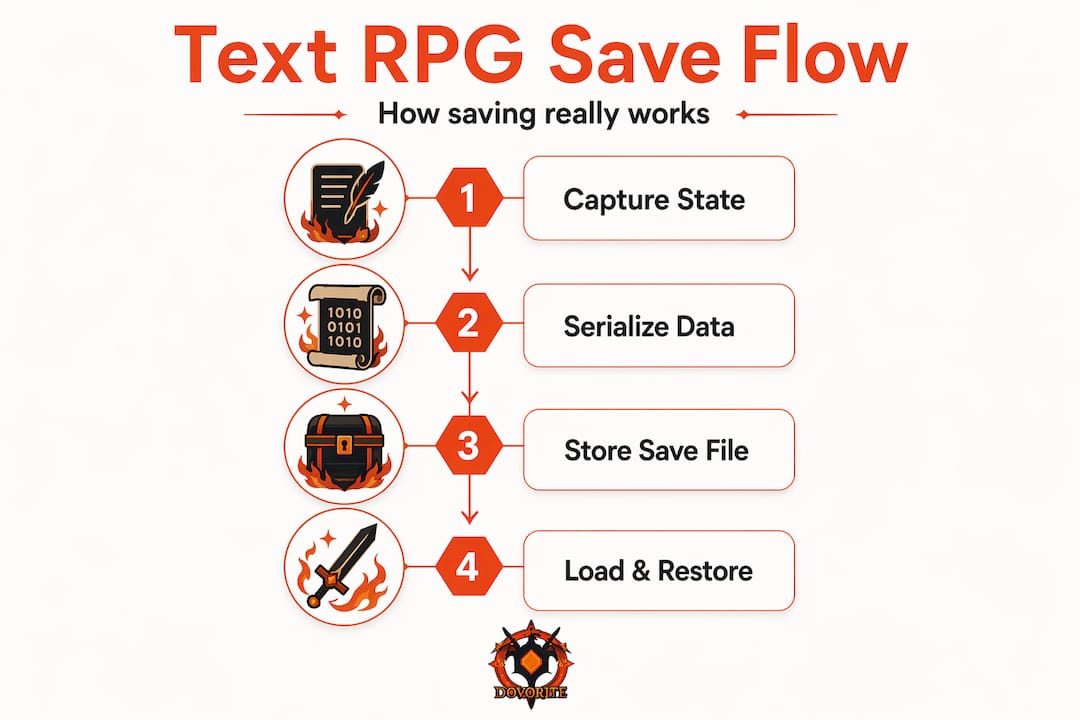
The interpreter position is where things get genuinely complex. When you save inside a dialogue sequence, the engine records which command index it was about to execute next. When you load, it jumps to that index and resumes. If the index points to the wrong place even by one step, you either skip a line or repeat one you’ve already seen.
Pro Tip: If you’re building a text RPG, treat the interpreter position as a first-class citizen of your save object. Don’t bolt it on as an afterthought. Serialize it alongside every other state variable from day one.
Best practice in 2026 is to save only changing state data periodically and after major events rather than writing the entire static data set every time. Saving player progress flags, inventory, and world changes every two to five minutes or upon significant events keeps files lean and load times fast.
Common pitfalls that break save systems
Knowing what to save is only half the battle. The other half is knowing what goes wrong when the save system isn’t built carefully. These are the failure modes that cause the most grief for both players and developers.
The most common culprit is the mid-dialogue save bug. Saving mid-dialogue in RPG Maker causes the interpreter’s index to point to the next message when the file is written. When you load, the engine resumes from that next index, so you’ve silently skipped a line of story. In branching narratives, this is worse. Saving at a choice screen means the choice callback closures must also be serialized and reconstructed on load. Most engines don’t do this automatically, which is why saves during active choices feel unpredictable.
File corruption is the second major problem. Crashes, power loss, or even a slow disk write can leave a partial save file that the game can’t parse. The modern solution is an atomic write pipeline: write the new save data to a temporary file, verify it, then rename the temp file to replace the old save. If the process is interrupted before the rename, the old save stays intact. GameMaker and Godot both use this approach, and any serious text RPG engine should too.

Autosave timing creates its own set of problems. Save too frequently and you risk trapping the player in a bad state with no way out. Save too infrequently and progress loss becomes a real frustration.
Pro Tip: Always implement at least one rotating backup slot alongside your active save. If the current save becomes unreadable, the backup from one session ago is often the difference between a recoverable situation and a player quitting permanently.
The deeper reliability principle worth understanding is that robust atomic saving with backups and explicit version numbers are what separate a save system that “sometimes works” from one that’s genuinely trustworthy. Silent corruption without version checking is the most insidious failure mode because neither the player nor the developer knows it’s happening until the damage is done.
Save design strategies and their tradeoffs
Not all text RPG save systems are built the same, and the design choices go far beyond convenience. Save mechanisms influence difficulty and gameplay style in ways that are often invisible until you change them.
Here’s how the three main strategies compare:
| Strategy | How it works | Best for | Main risk |
|---|---|---|---|
| Save anywhere | Player saves at any point in the game | Long-form narrative games | Savescumming; mid-dialogue bugs |
| Checkpoint autosave | Game saves automatically at story milestones | Tension-driven RPGs | Progress loss if checkpoints are too sparse |
| Manual save points | Dedicated save locations in the world | Classic dungeon-style text RPGs | Player frustration if save points feel arbitrary |
Save-anywhere systems feel generous, but they create the most technical complexity and open the door to savescumming. That’s when a player saves before a dice roll or a dangerous choice, sees a bad outcome, and immediately reloads to try again. Some players love this. Others feel it hollows out the tension. For developers building dice-based or consequence-heavy text RPGs, it’s worth deciding early whether savescumming is a feature or a problem.
Checkpoint autosaves create natural tension because the player can’t easily undo decisions. This suits games where consequences are meant to stick. The tradeoff is that poorly spaced checkpoints feel punishing, especially if a player makes a story choice they regret and can’t revisit it.
Manual save points land somewhere between the two. They reward players who are thoughtful about when they save, but they require world design that makes save access feel organic rather than arbitrary.
Save states in AI-driven text RPGs
This is where text-based game save systems face their newest and most interesting challenge. When a large language model (LLM) is powering the narrative, the traditional concept of saving the interpreter position doesn’t apply. The model generates text dynamically, so there’s no fixed script index to record.
Instead, LLM-based text RPGs separate durable mechanics state from narrative session context. Durable state includes health points, inventory, quest flags, relationship scores, and any scalar data that defines where the player is in the game world. Narrative context is the flowing conversation history that shapes the AI’s tone and continuity.
The reason this separation matters is state drift. If you try to use the entire chat transcript as your save file, you hit two problems fast. The transcript grows too large for the model’s context window, and the model starts treating older story events inconsistently. Persistent memory pipelines solve this by extracting key scalar facts from the conversation and storing them in a structured data layer completely separate from the story text.
Practically, this means a developer building an LLM text RPG should maintain two data stores: a compact mechanics object with all durable game state, and a rolling narrative summary that feeds the model enough context to stay coherent without ballooning to thousands of tokens. When the player saves, the mechanics object is written to disk. When they load, that object is injected back into the model’s system prompt alongside a brief story summary.
My honest take on save system design
I’ve spent years reading and playing text RPGs, and the pattern I keep seeing is this: developers spend enormous energy on narrative branching and almost none on save architecture, until something breaks badly.
The save-anywhere approach sounds like pure player freedom, but I’ve watched it introduce bugs that undermined beautifully written stories. The interpreter position problem alone has sent players backward through scenes they’d already resolved, which breaks immersion faster than almost any other failure. Fixing it after the fact is painful. Building it right from the start takes maybe a few extra hours of architecture work.
What I’ve found is that the most satisfying text RPGs treat saving as part of the game design, not a utility bolted onto the side. When a checkpoint save drops at a genuinely dramatic moment, it signals to the player that what just happened mattered. That’s not just technical competence. It’s storytelling.
My advice to developers: write your save and load logic before you write your second scene. Test it obsessively with edge cases like saving mid-choice, loading from a backup, and loading a file saved on a previous version. And to players: if your text RPG lets you save mid-dialogue, be cautious. That feature is only as reliable as the engine underneath it.
— Corban
Experience text RPG saves done right with Dovorite
If reading this has made you want to actually play a text RPG where the save mechanics hold up under pressure, Dovorite Chronicles is worth your time. Built as a playable fantasy adventure novel, Dovorite takes the architecture discussed in this article seriously. Your choices, your stats, and your story flags are preserved faithfully so the saga you’re building stays yours across sessions.

Every strategic dice roll and branching decision you make gets carried forward accurately, which means the consequences of your choices actually persist the way a good RPG demands. Whether you’re a player who wants to trust the save system or a developer studying how it’s implemented in a live product, subscribing to Dovorite puts you inside an experience worth examining from both angles.
FAQ
What data does a text RPG save state include?
A text RPG save state captures player stats, inventory, story flags, world event states, and the interpreter’s script position. Anything that can change during play needs to be serialized into the save file.
Why does my text RPG skip dialogue after loading a save?
This happens because the game’s interpreter index advanced to the next line when you saved mid-dialogue. On load, the engine resumes from that index, silently skipping the line you were on.
What is the safest way to prevent save file corruption?
Atomic write pipelines write new data to a temporary file first, then rename it to replace the existing save only after a successful write, so a crash never leaves you with a partial or unreadable file.
How do AI text RPGs handle saving progress?
AI-driven text RPGs store durable mechanics state such as health, inventory, and quest flags as structured data, separate from the narrative conversation context. This prevents state drift when the chat history grows too large for the model to handle reliably.
Does save system design affect gameplay difficulty?
Yes. Diegetic save mechanisms shape player behavior significantly. Save-anywhere systems allow savescumming that reduces tension, while checkpoint autosaves preserve the weight of player decisions by making them harder to undo.