How Text RPG Quests Are Structured for Writers

Text RPG quests are structured as modular, stage-driven tasks that alter the game state through explicit tracking of objectives, player choices, and narrative conditions. Understanding how text RPG quests are structured separates forgettable fetch tasks from stories players replay for years. Unlike graphical MMOs where quest content is locked behind art pipelines, text-based adventures built by platforms like Iron Realms, systems documented by Games by Hyper, and research from CHI 2023 prove that text quests can emerge dynamically from live world events. The result is a format where narrative and mechanics are inseparable.
How text RPG quests are structured at the core level
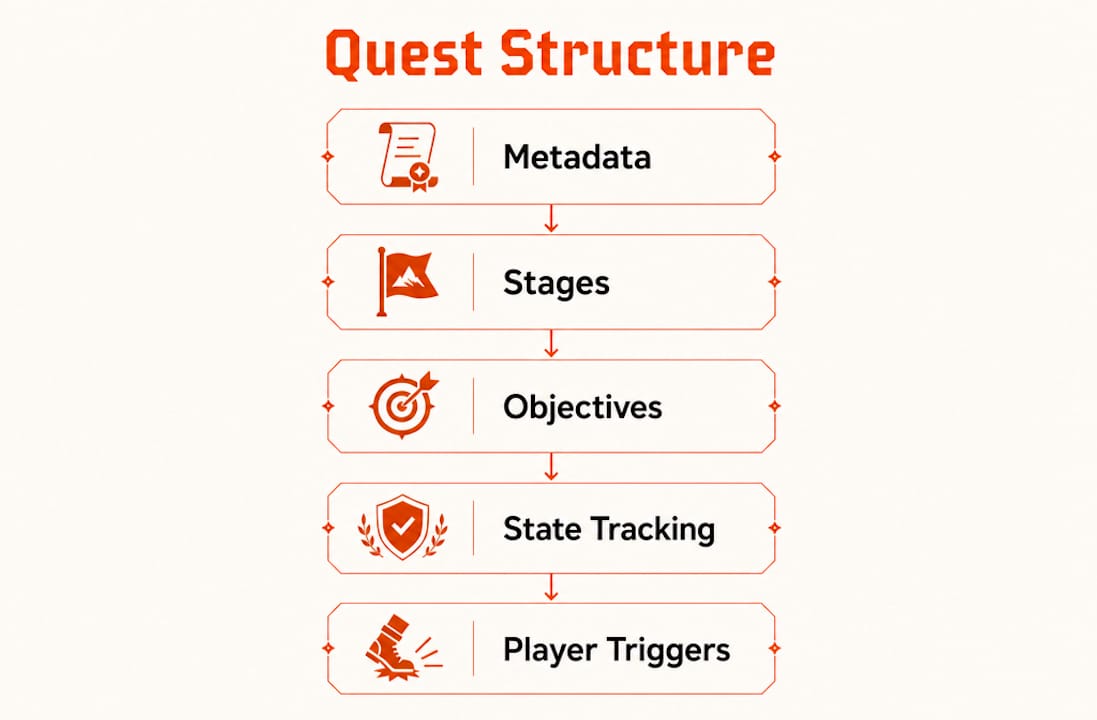
Every text RPG quest is built from the same foundational components, regardless of the engine behind it. Quest metadata carries the title, description, and grouping information that tells the player what they are doing and why. Below that sits a stages array, where each stage holds two distinct text logs: one displayed while the quest is in progress and one displayed after completion. This separation is not cosmetic. It lets the game world acknowledge what the player has done without reusing the same text twice.
Objectives sit inside each stage and define the actual win conditions. Common objective types include kill targets, item delivery, escort tasks, and puzzle solutions. Each objective type requires a different trigger to advance the quest state. A kill objective listens for a combat event. A delivery objective checks inventory. A puzzle objective waits for a specific player input or world condition.

The data behind all of this is typically stored in a structured quest format using fields like quest name, description, stages, objectives array, and state variables. JSON is the most common external format because it separates content from code. Externalizing quest data into resource files allows writers to iterate on dialogue and objectives without touching progression logic, which means a narrative designer and a systems programmer can work on the same quest simultaneously.
| Component | Function |
|---|---|
| Quest metadata | Stores title, description, and category for player-facing display |
| Stages array | Holds in-progress and completed log text for each phase |
| Objectives | Defines win conditions: kill, deliver, escort, or solve |
| State variables | Tracks current quest phase and triggers event-driven transitions |
| Rewards block | Specifies experience, items, or world-state changes on completion |
Pro Tip: Store quest text in external JSON files from day one. Changing a single line of dialogue should never require recompiling your quest logic.
What makes text RPG quests different from scripted MMO quests
Text RPG quests are often player-driven and can emerge from live world events rather than pre-scripted triggers. This is the defining structural difference between text-based adventure design and graphical MMO quest design. In a graphical MMO, every quest requires art assets, voice lines, and cutscene triggers, so content ships in patches. In a text RPG, a faction moving its territory or a seasonal world arc can spawn a new quest the same day it is written.
Text worlds can react faster than graphical MMO art pipelines, which means quest designers have a structural advantage. A quest can go unmarked until completion, rewarding exploration over checklist behavior. Some quests occur only once per player, making them feel genuinely personal rather than shared content everyone experiences identically.
This flexibility produces four distinct quest categories worth knowing:
- Faction quests tie completion to a player’s standing with a group, so the same objective yields different rewards depending on allegiance.
- Event quests spawn from live world conditions like sieges, seasonal changes, or player-triggered arcs, and they expire when the event ends.
- Honors quests track cumulative player behavior over time rather than a single session, rewarding consistency.
- Discovery quests activate silently when a player enters a location or examines an object, with no prior announcement.
“The best text RPG quests do not announce themselves. They reward players who pay attention to the world rather than players who follow a marker.” — Iron Realms player guide philosophy
How quest state tracking actually works in practice
Quest state management is the technical backbone of any text-based adventure structure. Typical quest states include Unknown, Mentioned, Accepted, Achieved, Completed, and a special override called Botched. Each state controls what the quest log displays and what events the quest system listens for. A quest in the Unknown state is invisible to the player. A quest in the Botched state is permanently failed and cannot be reactivated without a designer explicitly allowing it.
The critical technical distinction here is between flags and states. Flags are immutable facts tied to events that already happened. States are mutable conditions that can change. Separating these two concepts prevents the most common bug in quest scripting: a branching path that accidentally overwrites a completed objective because a state variable was reused.
| Approach | Best for | Risk |
|---|---|---|
| Global quest flags | Simple linear quests with one outcome | Flags accumulate and become hard to audit |
| State variables per quest | Multi-stage quests with branching | Requires careful initialization to avoid null states |
| Node graph model | Non-linear quests with converging paths | Higher design complexity upfront |
| Externalized QuestRunner | Iterative narrative development | Needs clear API between data and logic layers |
Player state should always be stored separately from quest logic. Rooms as nodes with descriptions, player inventory, and flags stored on the player object rather than the quest object make save and load systems dramatically simpler. When the quest logic only reads player state rather than owning it, reloading a save cannot corrupt an active quest.
Pro Tip: Build a QuestRunner that listens for completion signals from quest data files. This lets you add new quests by dropping in a JSON file rather than writing new code for every quest.
What narrative strategies make players actually finish quests
Players skip dialogue and abandon quests when overloaded with meaningless objectives. This is the single most documented failure mode in RPG quest design. The fix is not shorter quests. The fix is quests where every objective visibly changes something in the world.
Effective RPG quest narrative techniques share three structural properties:
- Consequential completion. The world looks or behaves differently after the quest ends. An NPC moves location, a door opens permanently, or a faction’s dialogue shifts. Players who see their choices reflected in the world repeat that behavior.
- Clear progress signaling. The quest log answers “what do I do next” without requiring the player to re-read the entire quest description. Each stage update should add one sentence of new direction, not replace the old text entirely.
- Evocative objective writing. “Kill 10 wolves” is a task. “Drive the Ashfang pack from the shepherd’s valley before the winter migration” is a quest. The second version contains a location, a reason, and a deadline. All three elements give the player a mental image to act toward.
Branching narratives add replay value but only when branches converge on meaningful differences rather than cosmetic ones. A graph-based quest model where multiple active steps converge at a shared resolution point reduces the linear checklist feeling without requiring the designer to write entirely separate quest trees for every choice. Writers building engaging text RPG quests should think in terms of decision points that change the path, not just the dialogue.
Lore integration amplifies all of these effects. When a quest objective connects to the world’s deeper history, players treat completion as discovery rather than obligation. The quest becomes a reason to read, not a reason to skip.
How AI and knowledge graphs change quest generation
AI-based quest generation uses a pipeline where player input is embedded and matched against knowledge graph relations by cosine similarity, then mapped onto quest templates before a language model generates NPC dialogue. This research from CHI 2023 represents the most technically rigorous approach to personalized quest design published to date.
The pipeline works in four steps:
- Player input is converted to an embedding vector and compared against NPC nodes in a knowledge graph.
- The highest-similarity path through the graph is selected and classified into a quest type such as delivery, combat, or investigation.
- A context-free grammar template is filled with entities from the selected path to produce a quest seed.
- A fine-tuned GPT-2 model generates NPC dialogue that matches the quest seed and maintains narrative consistency.
Anchoring generation to knowledge graph traversals ensures that dynamically created quests remain coherent with established world lore. The challenge is maintaining that coherence as the knowledge graph grows. Poorly connected graphs produce quests that feel random rather than emergent. Designers using AI-assisted quest tools from platforms like Librida’s interactive fiction research note that the quality of the knowledge graph matters more than the quality of the language model.
Key takeaways
Text RPG quest structure works because modular data, explicit state tracking, and player-driven triggers combine to produce narratives that respond to choices rather than just recording them.
| Point | Details |
|---|---|
| Modular quest data | Store metadata, stages, and objectives in external JSON files for clean iteration. |
| Flags vs. states | Keep flags immutable and states mutable to prevent branching logic errors. |
| Quest state model | Use Unknown through Completed states to control visibility and event listening precisely. |
| Player-driven emergence | Design quests that spawn from live world events, not just pre-scripted NPC triggers. |
| Narrative consequence | Every quest completion should visibly change the world to sustain player motivation. |
Why I think most quest systems are overengineered before they are understood
I have read through dozens of quest system implementations, from The Mana World’s backend state variables to the CHI 2023 AI pipeline, and the pattern I keep seeing is designers reaching for complexity before they have mastered the basics. A five-state quest model with clean flag separation will outperform a twenty-state system with tangled global variables every single time. The text RPG format’s greatest structural advantage is also its greatest trap: because there are no art assets to constrain scope, writers and designers keep adding states, branches, and conditions until the system collapses under its own weight.
The quest systems I find most worth studying are the ones that treat replay value as a design constraint from the start, not an afterthought. When you know a player will run the same quest twice, you write objectives that reveal new information on the second pass rather than just repeating the first. That discipline forces clarity in the initial design.
My practical recommendation: build the simplest state model that handles your most complex planned quest, then stop. Every additional state you add is a new failure mode. Text RPGs earn their depth from writing quality and world reactivity, not from the number of flags in a save file.
— Corban
Experience quests that are actually built this way

Dovorite Chronicles is built on exactly the structural principles covered in this article. Dynamic quest triggers, player-driven narrative branches, and AI-enhanced dialogue generation are not theoretical here. They are the engine behind every story on the platform. If you want to experience what well-structured text RPG quests feel like from the player side, or study them as a writer looking to sharpen your own designs, Dovorite Chronicles is the place to start. Every choice you make shifts the world state. Every quest completion means something. That is not a promise. It is the architecture.
FAQ
What are the basic components of a text RPG quest?
A text RPG quest contains quest metadata, a stages array with in-progress and completed logs, an objectives block defining win conditions, and state variables that track progression. These components work together to drive event-based transitions through the quest lifecycle.
What is the difference between quest flags and quest states?
Flags are immutable facts tied to events that already occurred, while states are mutable conditions that change as the quest progresses. Keeping these separate prevents branching logic errors and makes quest backtracking or reactivation far easier to manage.
How do text RPG quests differ from graphical MMO quests?
Text RPG quests can emerge dynamically from live world events and player actions without requiring new art assets, while graphical MMO quests are typically pre-scripted and shipped in content patches. This makes text-based adventure structure faster to iterate and more responsive to player behavior.
How does AI generate quests in text RPGs?
AI quest generation embeds player input, traverses a knowledge graph by cosine similarity to find relevant NPC paths, fills a grammar template with those entities, and then uses a fine-tuned language model to produce NPC dialogue. The CHI 2023 research pipeline from ACM demonstrates this approach in detail.
Why do players abandon text RPG quests?
Players abandon quests when objectives feel meaningless and completion changes nothing in the world. Quest systems that tie every stage to a visible world-state change and answer “what do I do next” clearly at each step produce significantly higher completion rates.