Why Playable Novels Appeal to Gamers: 2026 Guide

Playable novels are interactive narratives that give readers direct control over story outcomes, making them one of the fastest-growing formats in both gaming and literary fiction. The appeal to gamers is direct: where a traditional novel asks you to follow a character, a playable novel makes you become one. Choices carry weight, consequences feel personal, and no two playthroughs are identical. Formats like LitRPG and visual novels have turned this concept into a mainstream phenomenon, with the LitRPG genre growing roughly 10% annually as of Q2 2026. That growth signals something real. Gamers are not just looking for better graphics or faster action. They want stories that respond to them.
Why playable novels appeal to gamers differently than books or games
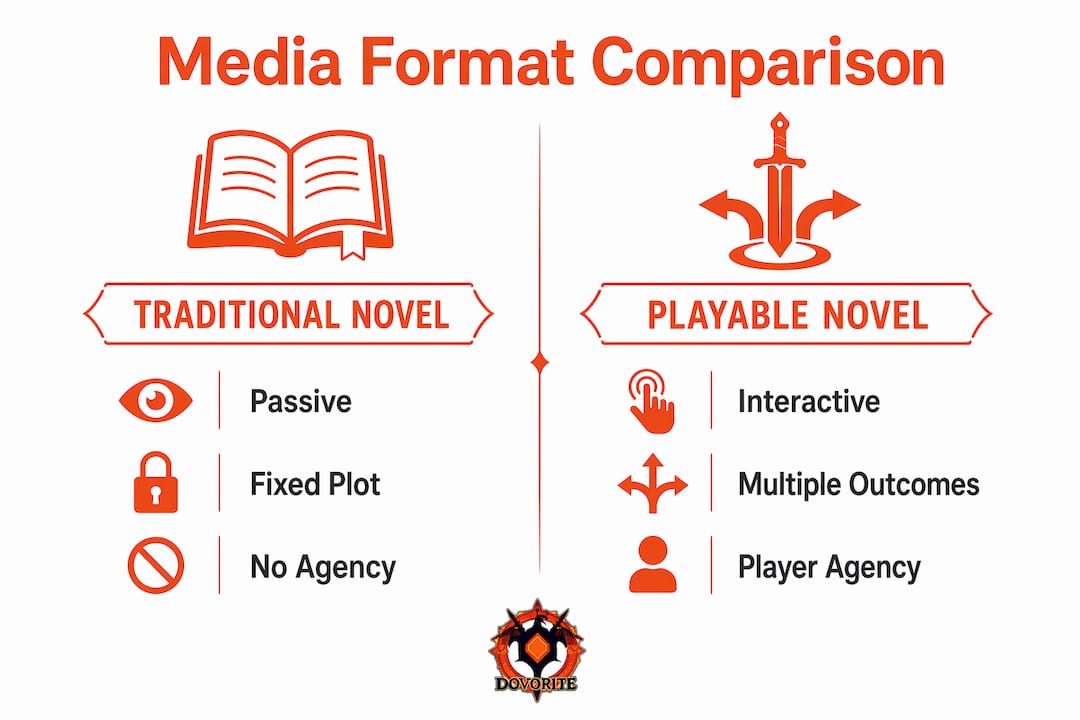
Playable novels occupy a space that neither traditional fiction nor conventional video games can fill alone. A standard novel delivers a fixed story. A typical action game delivers mechanics with a story layered on top. Playable novels flip both formulas by centering the entire experience on narrative decisions.
The differences between novels and playable novels come down to one word: agency. In a traditional novel, you observe. In a playable novel, you decide. That shift changes how you process the story emotionally. Gameplay in playable novels centers on social, moral, and emotional decision-making rather than physical skill, which means the challenge is internal. You are not dodging bullets. You are choosing whether to trust a character, sacrifice an ally, or reveal a secret.

Compare that to a typical video game, where narrative often serves as connective tissue between action sequences. In playable novels, the narrative is the game. Visual novels like Clannad and Danganronpa built massive audiences by treating dialogue and moral choices as the primary gameplay loop. LitRPG titles add stat tracking and progression systems on top of prose, giving gamers the satisfaction of character growth without abandoning the story.
Here is a direct comparison of the three formats:
| Feature | Traditional novel | Typical video game | Playable novel |
|---|---|---|---|
| Player agency | None | Mechanical (combat, puzzles) | Narrative (choices, relationships) |
| Story control | Fixed | Limited | Branching, personal |
| Replay value | Low | High (skill-based) | High (story-based) |
| Emotional investment | Passive | Moderate | Active and personal |
| Primary challenge | Comprehension | Reflex or strategy | Moral and emotional judgment |
Visual novels also layer in music, voice acting, and anime-style art to deepen immersion. Visual novels comprised nearly 70% of PC games released in Japan during the mid-2000s, which shows this format has never been a niche curiosity. It was, and remains, a dominant storytelling medium for a large portion of the gaming world.
Pro Tip: If you are new to playable novels, start with a short-form interactive fiction title before committing to a 40-hour visual novel. You will get a feel for how choices function without the time investment.
How player agency creates emotional depth and personal investment
Interactive stories hit harder than traditional books because players live with the consequences of their own decisions. That is the core psychological mechanism behind the appeal. When you choose to betray a character in a playable novel, you cannot blame the author. You made the call. That ownership transforms passive sympathy into genuine emotional stakes.
The most effective playable novels treat the player as a co-author. Your decisions shape personality arcs, alter relationships, and redirect plot trajectories. False choices that lead to identical outcomes destroy this effect entirely. Successful playable novels ensure choices leave lasting effects on personalities and plot arcs, which is why players return for second and third playthroughs. They want to see what would have happened differently.
“A single vivid choice forcing irreversible consequences can generate more narrative investment than complex multi-branching trees.” This insight from interactive story design research explains why the most memorable moments in playable novels are rarely the obvious big decisions. They are the quiet ones. The moment you chose to stay silent. The moment you gave something away you could not get back.
What makes this emotionally distinct from film or traditional fiction is the absence of distance. A reader watching a character make a terrible choice can feel sympathy. A player who made that choice feels something closer to regret, pride, or responsibility. That emotional specificity is why gamers who love playable novels describe them as some of the most affecting experiences in any medium.
Pro Tip: Pay attention to which choices feel irreversible. Those are the moments designers have invested the most in. Sit with them before you click.
What subgenres and formats attract diverse gamer audiences
The playable novel category contains several distinct formats, each drawing a different segment of the gaming audience. Understanding the types of playable novels helps explain why the format has grown beyond any single demographic.
LitRPG is the most gamer-native subgenre. It combines prose storytelling with explicit stat systems, level-ups, and skill trees, giving readers the narrative satisfaction of a novel alongside the progression loop of an RPG. The primary demographic for LitRPG titles is gamers in their 30s, a group that grew up on role-playing games and now wants that same structure wrapped in literary depth.
Visual novels attract a broader audience, including a significant share of women. Women make up 46% of the gaming market as of May 2026, and playable novels are one of the formats most responsive to that demographic shift. Character-driven stories with diverse protagonists, complex relationships, and identity-affirming themes resonate with players who have historically been underserved by action-heavy games.
Short-form interactive fiction represents a third format, designed for high engagement in minimal time. Short interactive fiction can be completed by players in 10 to 20 minutes, making it a practical format for mobile audiences and casual readers who want a story experience without a multi-hour commitment.
The subgenres also vary by tone and theme:
- LitRPG: Stat-driven progression, fantasy or sci-fi settings, gamer-native mechanics
- Visual novels: Anime-style art, voice acting, romance and mystery arcs, strong character focus
- Interactive fiction: Text-based, browser or mobile-friendly, often experimental in structure
- Playable fantasy adventure: Branching paths, dice mechanics, world-building depth, high replay value
This variety is a core reason for the format’s growth. There is a playable novel for nearly every type of reader or gamer, which expands the audience far beyond any single genre community. You can explore diverse playable novel platforms to find the format that fits your preferences.
How playable novels are created and distributed to reach gamers
The production side of playable novels has changed significantly in the past few years, and that change directly affects how many titles reach players. Indie development has become the dominant model, and the tools available now make creation accessible to solo writers and small teams.
Web-based and browser-playable visual novels have removed the barrier of app store approval and device compatibility. A creator can build and publish a playable novel as a web app, reaching players on any device without a download. This distribution model has expanded the catalog of available titles dramatically.
AI tools have accelerated production timelines. AI tools reduce production time for indie visual novel developers by 20%, with nearly half of indie creators using AI for writing and art as of 2026. That efficiency gain means more human-written playable novels reach completion and release, rather than stalling in development. The creative vision remains the author’s. The tools just remove friction.
Distribution follows several proven paths:
- Steam: The largest PC gaming storefront, with a dedicated visual novel category and an established audience for narrative games
- Mobile app stores: iOS and Android reach casual players who prefer short sessions and touch-based interaction
- Browser platforms: Itch.io and dedicated story platforms allow free-to-play access with optional monetization
- Dovorite: A platform built specifically for playable fantasy adventure novels, combining branching narratives with dice mechanics and character-driven storytelling
Free-to-play models and social sharing features drive discovery. Players who finish a playable novel and share their ending on social media create organic word-of-mouth that no advertising budget can replicate. The replay value strategies built into well-designed playable novels also keep players returning, which compounds that organic reach over time.
Key takeaways
Playable novels appeal to gamers because they merge narrative agency with emotional consequence, creating a personal story experience that neither traditional novels nor conventional games can replicate.
| Point | Details |
|---|---|
| Agency defines the format | Playable novels replace passive reading with active decision-making that shapes plot and character arcs. |
| Emotional stakes are higher | Players own their choices, which creates deeper emotional investment than observing a fixed story. |
| Subgenres serve diverse audiences | LitRPG, visual novels, and interactive fiction each attract different demographics, including the 46% female gaming market. |
| Production is increasingly accessible | AI tools and web-based platforms have lowered the barrier to creating and distributing playable novels. |
| Replay value is built in | Branching paths and meaningful consequences give players strong reasons to return for multiple playthroughs. |
Why I think playable novels are the most underrated storytelling format right now
I have spent years reading fiction and playing narrative games, and the format that has left the deepest marks on me is neither. It is playable novels. Specifically, the moments where I made a choice I could not undo and had to sit with it for the rest of the story.
What most commentary on this format gets wrong is the assumption that more branching equals more depth. It does not. The titles that stay with me are the ones with fewer choices, not more. One irreversible decision, written with precision, does more emotional work than a sprawling decision tree where every path leads to the same place. The craft is in making the player feel the weight before they click, not just after.
The other thing I believe strongly: playable novels are not a gateway format. They are not what you play before you graduate to “real” games or “serious” literature. They are their own thing, and they do something neither medium can do alone. The narrative depth in text RPGs that the best titles achieve rivals anything in literary fiction. The difference is you built that world alongside the author.
The growth numbers support what I have experienced personally. The audience for this format is not a niche. It is a generation of players who grew up wanting stories that respond to them, and the tools to create those stories have finally caught up with the demand.
— Corban
Experience playable novels with Dovorite Chronicles
If you want to understand why playable novels resonate with gamers, the fastest path is to play one. Dovorite Chronicles builds exactly the kind of experience this article describes: branching narratives, strategic dice mechanics, and character-driven stories where every choice shapes your personal saga.

Titles like The Living Ink Chronicles and Blood Moon Rising put you inside fantasy worlds where your decisions carry real narrative weight. The platform is designed for gamers who want story depth without sacrificing the engagement loop they expect from games. Start your playable fantasy adventure on Dovorite Chronicles and see firsthand what makes this format so hard to put down.
FAQ
What is a playable novel?
A playable novel is an interactive narrative where the reader makes choices that directly affect the story’s outcome, characters, and endings. It combines prose-driven storytelling with game mechanics like branching paths, stat tracking, and relationship systems.
How do playable novels differ from ebooks?
Ebooks deliver a fixed text with no interactivity. Playable novels give readers agency over plot direction, character relationships, and story endings, making each playthrough a personally unique experience.
What are the main types of playable novels?
The primary types are LitRPG (stat-driven progression with prose), visual novels (art and music-enhanced narrative games), and short-form interactive fiction (text-based, quick-play stories). Each format serves a different segment of the gaming and reading audience.
Why do gamers prefer playable novels over traditional games?
Playable novels prioritize narrative and emotional decision-making over physical skill, which appeals to gamers who want story depth and personal consequence rather than reflex-based challenges.
Are playable novels popular with audiences beyond core gamers?
Yes. With women comprising 46% of the gaming market as of 2026, playable novels attract a broad audience by offering identity-affirming stories, diverse protagonists, and character-focused gameplay that resonates well beyond the traditional gamer demographic.