
How Dialogue Trees Work in Text RPG Design

Dialogue trees are structured conversation frameworks that let players select responses from a list, directly determining NPC reactions and narrative branching in text RPGs. The industry term for this system is a branching dialogue system, and understanding how it works mechanically separates games that feel alive from ones that feel scripted. Tools like Yarn Spinner, Ink, and Twine each implement this concept differently, but the underlying logic is the same: nodes hold dialogue states, player choices trigger transitions, and variables track everything that matters. If you’re building a text-based game, mastering how dialogue trees work is the single highest-leverage skill you can develop.
How dialogue trees work in a text RPG: the core mechanics
A dialogue tree is a state machine at its core, where each node represents a dialogue state and each player choice acts as a transition to the next state. This model allows complex branching and dynamic routing based on game state and player input. The player never sees the machine. They see a character speaking, options appearing, and a story responding.
Here is how the mechanical flow breaks down step by step:
- Enter a node. The system loads the current dialogue node, which contains NPC text, speaker data, and any conditions that must be met to display it.
- Evaluate conditions. Before rendering choices, the system checks variables. Has the player met this NPC before? Did they complete a prior quest? Conditions gate which options appear.
- Display choices. The player sees a filtered list of responses. Each choice links to a target node and may carry side effects like variable updates or event triggers.
- Execute transitions. The player selects a response. The system updates variables, fires any attached events, and loads the next node.
- Reach an exit node. The conversation ends, returning control to the game loop with all state changes preserved.
Variable management is where most developers underestimate the complexity. Dialogue systems track three scopes: local variables handle specifics within a single conversation, global variables track world state across all systems, and persistent flags survive save and load cycles. A choice made in chapter one that affects chapter five requires a persistent flag. Forgetting that distinction creates bugs that are extremely hard to trace.
Pro Tip: Label every variable with its scope prefix during development. Use local_, global_, and persist_ as naming conventions. This one habit prevents hours of debugging when conversations start behaving unexpectedly.

Presentation matters as much as logic. Text effects like typewriter scrolling, timed pauses, and speaker portraits all influence pacing. Input handling must account for keyboard navigation, mouse clicks, and controller support if you plan to ship on multiple platforms. The UI layer is not decoration. It is part of the conversation design.
What makes dialogue choices actually matter?
The most common mistake in text RPG conversation design is offering choices that feel meaningful but produce identical outcomes. Narrative designer Sam Kabo Ashwell argues that choice text must reflect player identity and character voice, not just advance the plot mechanically. A choice between “Yes” and “Sure” is not a real choice. A choice between “I’ll help you, but I want something in return” and “I’ll help because it’s right” tells the player who their character is.
Strong dialogue design follows several principles that separate functional trees from memorable ones:
- Avoid vending-machine choices. If every option leads to the same NPC response with minor wording changes, players learn to stop caring. Each branch should produce a meaningfully different reaction or consequence.
- Use the branch and bottleneck structure. The foldback method forces reconvergence at key narrative points, preventing exponential content growth while preserving player agency. Branches diverge, then merge back at a shared story beat.
- Delay consequences for maximum impact. Immediate consequences feel mechanical. When a choice made in act one surfaces as a consequence in act three, players feel the world is genuinely tracking their decisions.
- Maintain character consistency across branches. Every NPC must sound like themselves regardless of which path the player took. Inconsistent character voice breaks immersion faster than any technical bug.
“The branch and bottleneck structure is the single most practical tool for keeping a branching narrative from collapsing under its own weight.” This approach lets you write ambitious stories without hiring a team of fifty writers to cover every permutation.
Foldback branching also reduces authoring workload dramatically. Instead of writing exponentially more content for each new branch, you write divergent moments that reconverge at shared scenes. The player experiences variation. You write a manageable script. That is the design contract that makes large-scale text RPGs possible.
Which dialogue tree tools and approaches should you use?
The implementation method you choose shapes everything from iteration speed to runtime performance. The core decision is between external data-driven formats and hardcoded scripts.
| Approach | Best For | Trade-offs |
|---|---|---|
| JSON / YAML files | Small to mid-size projects | Easy to edit, harder to visualize |
| Yarn Spinner | Unity integration, narrative-heavy games | Visual editor, strong community |
| Ink | Parser-style text games, Inkle Studios workflow | Compact syntax, steep learning curve |
| Twine | Prototyping, browser-based games | Limited engine integration |
| Hardcoded scripts | Tiny projects or proof-of-concept | Fast to write, painful to maintain |
| AI-driven (GPT-4 style) | Dynamic NPC personality, open-ended dialogue | Latency risk, cost, consistency challenges |
Separating dialogue content from game logic using external editable formats like JSON, CSV, or custom markup is the standard recommendation for any project beyond a prototype. Writers can edit dialogue files without touching the codebase. Designers can restructure trees without breaking game logic. That separation pays dividends every sprint.
For system integration, the event bus pattern is the cleanest architecture for connecting dialogue choices to quest systems and world state. Broadcasting named events lets quest trackers, reputation systems, and world flags all listen and react without brittle direct references between systems. In Godot 4, this maps directly to the Signals system. In Unity, you implement it manually or use a library like UniRx.
AI-driven dialogue using models like GPT-4 introduces a different set of trade-offs. Well-crafted prompt engineering and context injection outperform raw model size for NPC personality and context coherence. A small, targeted model with a precise system prompt beats a large general model with a vague one. The challenge is latency and cost at scale.
Pro Tip: If you integrate AI dialogue, build a static fallback tree for every NPC. When the AI call fails or times out, the fallback keeps the conversation alive. Players should never see a broken conversation.
For developers exploring how companion systems connect to dialogue, the event bus approach is especially relevant. Companion reactions, loyalty shifts, and relationship flags all need to respond to dialogue choices without creating spaghetti code.
How to implement dialogue trees without breaking your game
Implementation discipline separates a dialogue system that ships from one that becomes a maintenance nightmare. Follow these steps to build a system that scales.
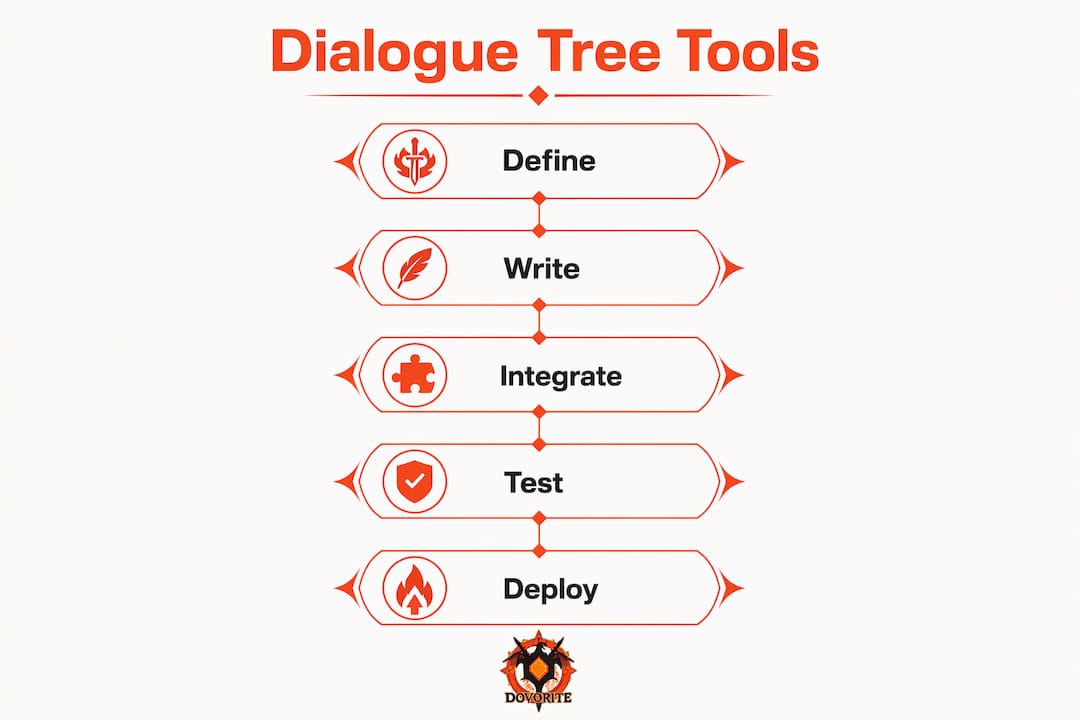
- Define your data schema first. Before writing a single line of dialogue, decide what a node contains: ID, speaker, text, conditions, choices, and effects. Lock this schema early. Changing it mid-project is expensive.
- Build a condition evaluator. Write a reusable function that takes a condition string and returns true or false based on current variable state. Every node’s visibility and every choice’s availability runs through this function.
- Implement variable scoping from day one. Tracking variables across local, global, and persistent scopes is non-negotiable for narrative consistency. Build the three-scope system before you write your first real conversation.
- Target sub-500ms response times. Response times under 500 milliseconds keep conversations feeling natural. For static trees, this is trivial. For AI-driven dialogue, it requires caching, streaming, and careful API management.
- Use text effects to control pacing. Typewriter effects, pause tokens, and speaker transitions give players time to read and feel the weight of each line. Pacing is a design tool, not a cosmetic feature.
Caching and streaming dialogue responses are non-negotiable for real-time text RPGs using dynamic generation. Pre-fetch likely next nodes during idle time. Stream long responses token by token rather than waiting for the full output. These two techniques alone cut perceived latency dramatically.
For writers and developers working together, good text RPG writing practices align directly with clean dialogue tree architecture. When writers understand node structure, they write dialogue that fits the system. When developers understand narrative intent, they build systems that serve the story.
Pro Tip: Build a dialogue debugger into your development build. Display the current node ID, all active variables, and the last five transitions taken. This single tool will save more debugging time than any other investment you make in your dialogue system.
Key takeaways
Effective dialogue trees combine state machine architecture, disciplined variable management, and deliberate design choices to create conversations that feel genuinely reactive and player-driven.
| Point | Details |
|---|---|
| State machine foundation | Every dialogue node is a state; every player choice is a transition to the next state. |
| Three-scope variables | Track local, global, and persistent variables from day one to maintain narrative consistency. |
| Foldback branching | Use branch and bottleneck structures to keep content manageable without sacrificing player agency. |
| Delayed consequences | Place the effects of player choices several scenes later to create a genuinely reactive world. |
| Separate data from logic | Store dialogue in external formats like JSON or Yarn Spinner files to speed up iteration. |
The part nobody talks about: character voice across branches
I’ve reviewed dozens of dialogue systems built by developers who got the architecture exactly right and still shipped conversations that felt hollow. The state machine was clean. The variables were scoped correctly. The foldback structure was in place. The problem was that every NPC sounded like the same person wearing different hats.
Character voice consistency across branches is the hardest problem in dialogue tree design, and it is almost never discussed in technical guides. When a player takes the aggressive path, the intimidating path, and the diplomatic path through the same NPC conversation, that NPC needs to respond differently each time while still sounding like themselves. That requires writing discipline that no tool enforces automatically.
My honest recommendation is to write a character bible for every significant NPC before you write a single node. Define their speech patterns, their emotional triggers, their limits. Then run every branch through that filter. If a response could belong to any NPC in your game, rewrite it.
The other thing I’ve learned is that developers consistently underestimate how much the reconvergence point matters. The foldback moment, where divergent branches merge back, is where players compare notes with other players. If the reconvergence scene feels identical regardless of path, the earlier choices feel retroactively meaningless. Write the bottleneck scene last, after you know what each branch established, and make sure it acknowledges the variation.
AI-driven dialogue is genuinely exciting for text RPGs, but treat it as a layer on top of a solid static system, not a replacement for one. The games that will get this right are the ones that use AI to add texture and surprise to a well-designed static tree, not the ones that hand the whole conversation to a language model and hope for the best.
— Corban
See dialogue trees in action at Dovorite chronicles
Reading about dialogue tree mechanics is useful. Playing a system that executes them well is better.

Dovorite Chronicles is a text-based RPG platform built around dynamic, branching dialogue that responds to every choice you make. Stories like The Last Dragon’s Hoard and The Paper Kingdom demonstrate foldback branching, persistent variable tracking, and delayed consequences in action. As a developer, playing through these stories gives you a concrete reference point for what well-implemented dialogue trees feel like from the player’s side. Visit Dovorite Chronicles to explore the full catalog and see how sophisticated conversation design translates into genuine player immersion.
FAQ
What is a dialogue tree in a text RPG?
A dialogue tree is a branching conversation framework where players select responses from a list, and each choice determines the NPC’s reaction and the story’s next direction. The industry standard implementation uses a state machine model where nodes are dialogue states and choices are transitions.
How do variables work in a dialogue system?
Dialogue systems use three variable scopes: local variables manage data within a single conversation, global variables track world state across all systems, and persistent flags survive save and load cycles. Tracking all three correctly is required for narrative consistency across a full game.
What is the branch and bottleneck structure?
The branch and bottleneck structure, also called foldback branching, lets dialogue paths diverge for player agency and then reconverge at shared narrative points. This prevents exponential content growth while keeping the story manageable for writers and developers.
Should i use yarn spinner, ink, or a custom system?
Yarn Spinner is the strongest choice for Unity projects with heavy narrative content, while Ink suits parser-style text games and the Inkle Studios workflow. Custom JSON-based systems work well for small projects where you need full control over the data schema.
How do i keep AI dialogue under 500ms response time?
Target sub-500ms latency by pre-fetching likely next nodes during idle time and streaming responses token by token rather than waiting for full output. Always maintain a static fallback tree so conversations continue if an AI call fails or exceeds the latency threshold.