
Puzzles in Text-Based RPG Design: A 2026 Guide

Puzzles in text-based RPG design are defined as narrative obstacles that require players to apply logic, observation, and deduction to advance the story. Unlike visual games where environmental cues do the heavy lifting, text-based RPGs place the entire cognitive burden on the player’s ability to read, interpret, and reason. That mental engagement is precisely what makes puzzles so powerful in this format. Tools like Inform 7 and legacy systems like ZIL from Infocom have shaped how designers think about puzzle parsing and state management. This guide gives you a practical framework for using puzzle mechanics in RPGs to deepen narrative engagement rather than frustrate your players.
How do puzzles enhance narrative engagement in text-based RPG design?
Puzzles function as plot infrastructure, not decoration. When a locked door in a text-based RPG requires the player to recall a detail from three rooms back, that puzzle is doing narrative work. It reinforces world consistency, rewards attentive reading, and makes the player feel like a genuine participant in the story rather than a passive observer.
The most effective approach is to treat every puzzle as a narrative plot point rather than a standalone challenge. In The Secret of Monkey Island, the insult swordfighting system works because it reflects the protagonist’s character arc and the comedic tone of the world. The puzzle is inseparable from the story. Text-based RPG designers should hold every puzzle to the same standard: if you removed it, would the story feel incomplete?

Thematic relevance directly affects player immersion and perceived challenge fairness. A puzzle that feels coherent with the world keeps players motivated. One that feels arbitrary breaks the fictional contract and sends players to walkthroughs.
Sensory and descriptive writing is your primary tool for embedding puzzles into the narrative. Descriptions of shadows or ambient sounds communicate puzzle clues far more effectively than direct exposition. “You hear a faint dripping from behind the north wall” is both atmospheric and functional. It tells the player something is there without announcing “CLUE: hidden passage.”
Multi-step puzzle structures create a narrative rhythm that single puzzles cannot. Clues spaced progressively across an area reinforce player memory without overwhelming them, and each small discovery feels like a story beat. The player is not just solving a puzzle. They are uncovering the world.
Key design principles for narrative puzzle integration:
- Tie every puzzle solution to a story revelation or world detail
- Use environmental descriptions to deliver clues rather than NPC exposition dumps
- Build puzzles that reference earlier story events to reward attentive players
- Ensure the puzzle’s theme matches the location’s tone and the character’s situation
Pro Tip: Before finalizing any puzzle, ask yourself: “What does solving this teach the player about the world or the character?” If the answer is nothing, redesign the puzzle or cut it.
What are best practices for designing puzzles suited for text-based RPGs?
Text-based game design demands a different cognitive contract than visual games. Players cannot click around to discover interactions. They must form a mental model of the space and reason from it. Your puzzle design must respect that process.
Follow these principles to build puzzles that feel fair and satisfying:
- Design for deduction, not trial and error. Every puzzle solution should be reachable through logic and observation. If a player must guess the correct verb or randomly combine items, the puzzle has failed. Provide enough contextual clues that a careful reader can solve it without outside help.
- Build puzzle dungeons, not puzzle rooms. Multi-step puzzle structures that span several connected areas build knowledge progressively. “Overclues,” which apply hints across an entire zone rather than a single room, reduce confusion and increase engagement.
- Vary your puzzle types. Inventory puzzles, environmental puzzles, and deductive reasoning puzzles each engage different cognitive skills. A game that relies exclusively on inventory combinations becomes predictable. Mix types to sustain interest across the full experience.
- Maintain player agency at all times. No puzzle should create a hard block where the player cannot progress at all. Design alternate paths or partial solutions that keep the narrative moving even when a puzzle remains unsolved.
- Respect the parser’s limitations. Text parsing is a UI constraint that directly shapes puzzle design. Avoid requiring obscure verbs or multi-word commands that the parser cannot reliably interpret. Noun disambiguation and scope hierarchies are critical to preventing player frustration at the interface level rather than the puzzle level.
- Use JSON or structured data for puzzle logic. Data-driven puzzle definitions allow you to iterate quickly, test edge cases, and keep item relationships consistent across a large game world.
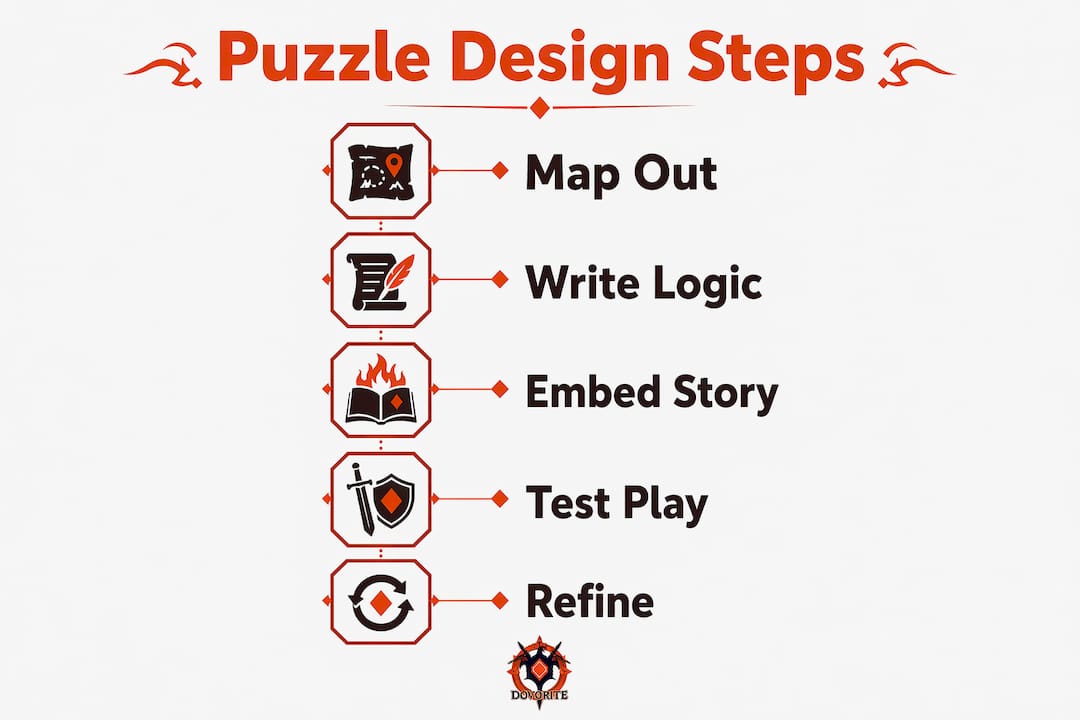
Pro Tip: Map every puzzle on paper before implementing it. Write out the player’s expected reasoning path step by step. If you cannot articulate that path clearly, the puzzle is not ready to build.
The importance of puzzles in RPGs is not just about challenge. It is about giving players a reason to engage with the world’s details. A well-designed puzzle rewards the player who reads every room description carefully. That reward loop is what separates memorable text-based RPGs from forgettable ones.
Which common pitfalls should designers avoid when integrating puzzles?
Most puzzle design failures come from one of two sources: over-engineering the technical systems or under-connecting the puzzle to the narrative. Both are avoidable with deliberate planning.
The most damaging mistake is spending the majority of development time on the parser engine rather than the writing. Developers should spend 80% of their time on narrative and puzzle writing, with only 20% on engine programming. Over-engineered parsers produce technically impressive but narratively empty games. Players remember stories and clever puzzles. They do not remember elegant verb handling.
Common pitfalls to watch for:
- Random trial and error mechanics. If players solve your puzzle by systematically trying every item combination, the puzzle is not testing intelligence. It is testing patience. Replace random solutions with logical ones that follow from the world’s internal rules.
- Thematically disconnected puzzles. A cryptography puzzle in a medieval fantasy dungeon breaks immersion unless the world has established a reason for it. Puzzles must integrate with the thematic fabric of the game world to sustain player motivation.
- Inadequate feedback loops. When a player attempts a wrong solution, the game’s response must be informative. “Nothing happens” is a failure state for the designer, not the player. Describe what did not work and why, in terms consistent with the world.
- Hard failure states. Puzzle failure should produce narrative consequences or alternative challenges rather than blocking all progress. Hard stops frustrate players and break narrative momentum.
- Parser disambiguation failures. When the game cannot determine which object the player means, the interaction collapses. ZIL’s scope models and flag systems remain relevant precisely because they solved this problem systematically. Modern designers should study them.
The thematic coherence of escape room puzzles offers a useful analog here. Escape rooms that succeed commercially are those where every puzzle feels like it belongs in the same story. Text-based RPG designers should apply the same standard.
How can designers integrate puzzles seamlessly within text-based RPG narratives?
Seamless puzzle integration starts before you write a single room description. It starts in your design document.
A design document, sometimes called a “bible,” maps every puzzle to a specific story beat, character motivation, or world detail. This practice, documented in the 1979 Infocom design process, remains the most reliable method for keeping puzzles narratively grounded. When you know why a puzzle exists in the story, you know how to clue it, how to reward it, and what failure should mean.
The following table compares two integration approaches to illustrate the difference in player experience:
| Approach | Method | Player experience |
|---|---|---|
| Isolated puzzle design | Puzzles built independently, then inserted into story | Feels arbitrary, breaks immersion, frustrates players |
| Narrative-first puzzle design | Puzzles designed from story beats and character arcs | Feels organic, rewards engagement, deepens world investment |
| AI-assisted rapid prototyping | Tools used to iterate puzzle logic and narrative feedback quickly | Faster iteration, more testing cycles, better balance |
AI-assisted tools have changed the prototyping process significantly. Building a Zork-sized text adventure now takes a novice roughly 3 to 5 hours with modern AI tools. That speed means you can test multiple puzzle configurations against the same narrative arc and identify which version produces the most satisfying player experience before committing to a final design.
Branching narrative structures and mystery investigation patterns are particularly well-suited to interactive puzzles in RPGs. When a puzzle’s solution reveals a plot twist or unlocks a character’s backstory, the player’s cognitive investment in solving it increases dramatically. The puzzle becomes a story delivery mechanism, not an interruption.
Pro Tip: Design at least one puzzle per act that reveals something the player did not know about the world. Puzzles that deliver lore as their reward create the strongest connection between mechanics and narrative.
Key takeaways
Puzzles in text-based RPGs work best when they function as narrative infrastructure, not isolated challenges, requiring designers to build every puzzle from story logic outward.
| Point | Details |
|---|---|
| Narrative-first design | Build every puzzle from a story beat or character motivation, not as a standalone challenge. |
| Multi-step puzzle structures | Span puzzles across connected areas to build knowledge progressively and create narrative rhythm. |
| Avoid hard failure states | Design narrative consequences for puzzle failure rather than blocking all player progress. |
| Parser-aware design | Use noun disambiguation and scope hierarchies to prevent interface frustration from undermining puzzle logic. |
| 80/20 development rule | Spend 80% of development time on writing and puzzle design, not on engine programming. |
Why puzzle design is the most underrated craft in text-based RPGs
I have reviewed and played dozens of text-based RPGs over the years, and the pattern is consistent. The games that stay with players are not the ones with the most sophisticated parsers or the largest room counts. They are the ones where solving a puzzle felt like a genuine discovery.
The mental gymnastics of deduction are the core experience of interactive fiction. That is not a metaphor. When a player sits with a text-based puzzle, they are building an internal model of the world, testing hypotheses, and revising their understanding. That process is cognitively satisfying in a way that no cutscene or dialogue tree can replicate.
What I find most designers underestimate is how tightly puzzle satisfaction is linked to narrative payoff. A puzzle that is mechanically clever but narratively empty produces a hollow “got it” moment. A puzzle whose solution recontextualizes the story produces the kind of moment players describe to other people. That is the difference between a good puzzle and a memorable one.
The best text-based RPG puzzles I have encountered share one quality: they make the player feel smarter about the world after solving them. Not smarter than the game. Smarter about the world the game built. That distinction is everything. Design toward it without compromise, and your puzzles will carry the narrative rather than interrupt it.
— Corban
Experience puzzle-driven storytelling with Dovorite Chronicles
If you want to see these principles in action, Dovorite Chronicles puts you inside playable fantasy adventure novels where puzzles are woven directly into the narrative fabric.

Every story in Dovorite Chronicles is built around the idea that your choices and your reasoning shape the saga. Puzzles are not obstacles between story beats. They are the story beats. Strategic dice rolls, branching consequences, and contextually grounded challenges combine to create an experience where solving a puzzle means advancing your character’s arc. Explore the full catalog of playable fantasy adventures and see how creative puzzle integration transforms reading into living the story.
FAQ
What is the role of puzzles in text-based RPG design?
Puzzles in text-based RPG design serve as narrative obstacles that require logical deduction and world engagement to solve. They advance the story, reward attentive players, and deepen immersion by making the player an active participant in the world.
How do puzzles enhance storytelling in text-based games?
Puzzles enhance storytelling by delivering lore, revealing character motivations, and creating narrative payoffs tied to player effort. When a puzzle’s solution unlocks a plot detail, the cognitive investment in solving it strengthens the player’s connection to the story.
What makes a text-based puzzle fair vs. frustrating?
A fair puzzle provides enough contextual clues for a careful reader to solve it through deduction alone. Frustrating puzzles rely on trial and error, obscure verb commands, or solutions disconnected from the game world’s internal logic.
Should puzzle failure block game progression?
Puzzle failure should never create a hard block. Good design produces narrative consequences or alternative challenges when a puzzle goes unsolved, keeping the story moving and the player engaged rather than stuck.
How long does it take to build a text-based RPG with puzzles today?
With modern AI-assisted tools, a novice can build a Zork-sized text adventure in roughly 3 to 5 hours. That speed enables rapid iteration of puzzle logic and narrative feedback before committing to a final design.