
How to Survive Early Game Text RPG Challenges

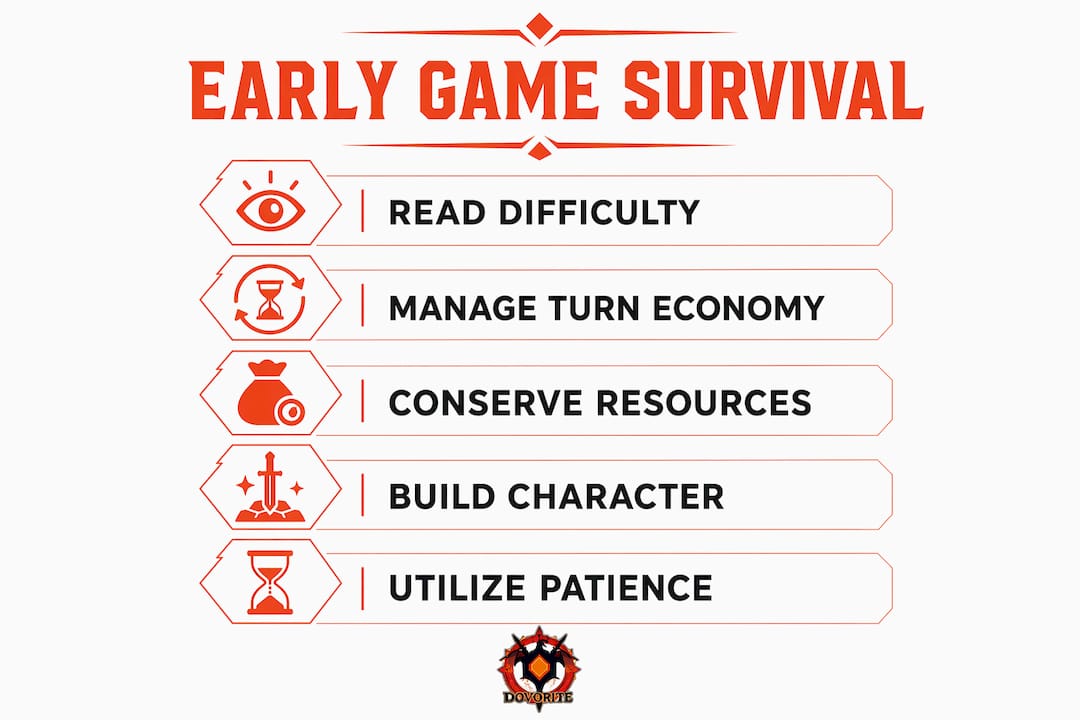
Surviving the early game in a text RPG is defined by three skills: reading enemy difficulty correctly, spending your turns wisely, and never wasting a resource you cannot replace. Games like Caves of Qud, Mewgenics, and Silverbrook all punish players who treat the opening hours as a warm-up. They are not. The first encounters set the tempo for everything that follows, and the players who thrive are the ones who treat every decision as consequential from turn one. This guide gives you the tactics that work, drawn from real game mechanics and community-tested strategies.
How to survive early game text RPG encounters by reading enemy difficulty
The single most effective beginner tip in any text RPG is learning to treat difficulty labels as hard data, not suggestions. Caves of Qud labels enemies with ratings like “average,” “very tough,” and “impossible.” The official early-game checklist is direct: flee immediately from anything labeled “very tough” or higher, and only engage “average” enemies one-on-one with caution. That rule alone eliminates the majority of early deaths.
Silverbrook applies the same logic through its full D&D 5e combat system. Every encounter carries implicit signals about threat level, and archetype-based survival depends on recognizing those signals before committing to a fight. A Fighter can absorb a hit and reassess. A Wizard who misreads a difficulty cue and gets locked into melee has no recovery option.
The practical application comes down to two rules. First, never engage a group when you can isolate a single enemy. Groups multiply action economy against you, and in a text RPG, you cannot out-damage three enemies taking turns simultaneously. Second, when you run, run with purpose.
- Identify the nearest terrain feature that breaks line of sight before you start fleeing
- Put walls, doors, or elevation between you and ranged attackers
- Keep moving until the enemy stops pursuing, not just until they fall behind
Pro Tip: Breaking line of sight is the most underused escape tool in text RPGs. Terrain blocks aim lines in Caves of Qud, meaning a ranged enemy chasing you through an open field is far more dangerous than one you’ve separated from with a single corner. Always run toward cover, not just away from the threat.
What is turn economy and why does it determine early survival?
Turn economy is the ratio of useful actions you take versus useful actions your enemy takes in the same time window. In early text RPGs, your character is fragile and your resources are thin. Spending turns on attacks that deal marginal damage while taking full hits in return is a losing trade every time.
The Mewgenics strategy community has documented this clearly. Passing your turn to force enemies to waste movement is a legitimate tactic, not a passive one. When an enemy spends its turn closing distance instead of attacking, you have effectively negated its action. That is a win without dealing a single point of damage.
The healing-kite loop is the practical expression of this principle. Here is how it works in sequence:
- Deal one round of damage to an enemy at range or from a safe position
- Retreat before the enemy can close and retaliate
- Use a healing item or rest action if your health dropped below a safe threshold
- Re-engage only when your health is stable and the enemy’s position is predictable
- Repeat until the enemy is defeated or the risk outweighs the reward
“One-turn fight rewards are usually negligible. Survival and team uptime matter far more than quick clears early on.” — Mewgenics community strategy guide
This loop feels slow. That is the point. Early game rewards in Mewgenics and similar games favor players who stay alive over players who finish fights fast. A dead character earns nothing.
Pro Tip: If you find yourself alpha-striking because a fight “looks winnable,” pause and count your remaining healing items. If you have fewer than two, the fight is not worth starting. Save the aggression for encounters you have already scouted.
How should you manage gear, items, and consumables early on?
Resource management in text RPGs follows one rule above all others: every consumable you use now is one you cannot use when things get worse. And things always get worse.

Caves of Qud makes this concrete with ammunition. Lead slugs are sold in limited quantities by merchants and are the primary ammunition for powerful missile weapons. Burning through them on low-armor enemies is a mistake you will feel three zones later when a high-armor enemy appears and your rifle is empty. Reserve expensive ammunition for targets where it provides a genuine advantage, specifically enemies with armor values that make melee ineffective.
Healing items follow the same logic, but with an added layer of situational awareness. Witchwood bark in Caves of Qud is a strong early-game option because it fully heals at low levels with only manageable confusion as a side effect. The catch is that confusion impairs your ability to navigate and react. Use witchwood bark only when you have already identified your escape route and are not in active combat.
- Save your strongest healing items for fights you cannot avoid, not fights you stumbled into
- Use light sources only when darkness is actively creating danger, not as a default setting
- Track your consumable counts before entering any new area, not after you have already committed
- Treat ammunition as a finite budget. Spend it like cash, not like a resource that refills on rest
The broader principle is that text RPG stats interact with consumables in ways that are not always obvious at first. A character with high Toughness may not need that healing item as urgently as a glass-cannon build. Know your character’s tolerances before you decide what to carry and what to leave behind.
How do character builds change your early game survival strategy?
Text RPG character building is not just about picking a class you like. It is about understanding which survival strategy your archetype supports and committing to it from the first encounter. Silverbrook’s D&D 5e combat system makes this explicit, and its single save slot means a build mismatch is not a minor inconvenience. It is a permanent setback.
| Archetype | Primary survival method | Key early-game risk |
|---|---|---|
| Fighter | Absorb damage, control positioning | Overcommitting to fights without healing access |
| Wizard | Kill targets before they close distance | Running out of spell resources in extended fights |
| Rogue | Evade, disengage, and exploit terrain | Getting cornered with no escape route available |
Each archetype demands a different opening posture. Fighters can afford to test an enemy’s damage output because they have the health pool to absorb one bad turn. Wizards cannot. A Wizard’s survival strategy is preemptive: identify the highest-threat enemy in a group and eliminate it before it acts. Rogues live and die by positioning. A Rogue in open terrain against multiple enemies is almost always a losing scenario.
Save state mastery becomes critical here because single save slots punish experimentation. The solution is to treat your first few runs as scouting missions. Learn the encounter patterns, identify which enemies your build handles cleanly, and build a mental map of which fights to avoid entirely. That knowledge transfers even when a run ends badly.
What early-game traps kill most text RPG beginners?
The most dangerous traps in early text RPGs are not the hardest enemies. They are the mechanics that punish inattention.
The WAIT command is the clearest example. In Goblin Cave Adventure, a 30-second idle timer advances the world state automatically, triggering enemy ambushes if you are not actively inputting commands. Players who pause to think at the prompt without realizing the game is still running have died to this mechanic more times than any difficult enemy. The fix is simple: keep inputs flowing, even if the input is just a look command or a map check.
“Experienced players keep inputs flowing or use invisibility rings to avoid automatic WAIT consequences.” — Goblin Cave Adventure community notes
Beyond idle timers, the second most common trap is the incentive to finish a fight quickly at the cost of survivability. A fight that looks like it is almost over is still dangerous. Taking unnecessary damage in the final two turns of an encounter because you wanted to end it faster is the kind of decision that compounds. That damage carries into the next fight, and the one after that.
- Never assume a fight is won until the enemy is defeated. Partial health enemies still deal full damage
- Check for hidden timers or world-state mechanics in any new game before settling into a rhythm
- Use text RPG writing guides and community wikis to identify game-specific pitfalls before they cost you a run
- Treat every new area as potentially hostile until you have cleared it at least once
Key takeaways
Surviving early text RPG stages requires reading difficulty labels correctly, protecting your turn economy, and treating every consumable as irreplaceable.
| Point | Details |
|---|---|
| Read difficulty labels | Flee from “very tough” or “impossible” enemies and only fight “average” foes one-on-one. |
| Protect turn economy | Pass turns to waste enemy movement and use healing-kite loops instead of alpha-striking. |
| Conserve consumables | Reserve ammunition and healing items for unavoidable encounters, not exploratory fights. |
| Match tactics to archetype | Fighters tank, Wizards kill fast, and Rogues evade. Build your opening strategy around your class. |
| Avoid idle traps | Keep inputs flowing in real-time text adventures to prevent automatic WAIT ambushes. |
Why patience is the skill nobody talks about in text RPGs
Most early-game deaths in text RPGs come from impatience, not ignorance. Players know the difficulty label says “very tough.” They fight anyway because the reward looks good or because retreating feels like losing. That instinct is the thing you actually need to train out of yourself.
What I have found after spending serious time with games like Caves of Qud and Silverbrook is that the players who progress furthest are not the ones who learn the most mechanics first. They are the ones who get comfortable with inconclusive outcomes. Running from a fight, burning a healing item to survive a bad turn, or spending three turns kiting an enemy instead of two: none of these feel satisfying in the moment. All of them are correct.
The community dimension matters more than most guides acknowledge. Wiki pages like the Caves of Qud early-game checklist exist because experienced players documented their failures in detail. Reading those before your first run is not cheating. It is the same preparation a competitive player would do before any serious match.
One caution: do not let the difficulty of early text RPGs become a reason to stop playing. Every death teaches you something specific about a mechanic, an enemy, or a decision pattern. The players who burn out are usually the ones treating each death as a failure rather than a data point. Treat it as a data point. The run that ends at hour two because you misread a difficulty label is the run that makes hour ten possible.
— Corban
Practice your survival skills with Dovorite Chronicles

Dovorite Chronicles offers a direct way to put these survival strategies into practice. The platform’s playable fantasy adventure novels combine strategic dice rolls with dynamic AI-powered storytelling, giving you a low-stakes environment to test encounter assessment, turn management, and resource decisions before they cost you a permadeath run. Every choice you make shapes the story, which means the consequences of a bad decision are immediate and instructive. If you want to build the instincts that carry you through brutal early-game scenarios, Dovorite’s interactive novels are the place to develop them.
FAQ
What is the fastest way to survive early text RPG fights?
The fastest path to survival is avoiding fights you cannot win, not winning fights faster. Use difficulty labels to filter encounters and only engage enemies rated “average” or lower when you have a health and resource advantage.
How do I know when to flee in a text RPG?
Flee immediately when an enemy is labeled “very tough” or “impossible,” when you are outnumbered, or when your healing items are already depleted. Breaking line of sight with terrain is the most reliable escape method against ranged attackers.
Does character class really affect early game survival?
Yes, significantly. Silverbrook’s archetype system shows that Fighters, Wizards, and Rogues each require a completely different opening strategy. Playing a Wizard like a Fighter is one of the most common causes of early-game failure.
What is the WAIT trap in text adventures?
Some text adventures like Goblin Cave Adventure run on a real-time idle timer that advances the world state if you stop inputting commands. Pausing to think at the prompt can trigger enemy ambushes without any warning.
How many healing items should I carry in early text RPGs?
Carry at least two healing items before entering any new area, and do not use them unless your health drops below 40 percent. Saving consumables for unavoidable encounters is the core principle of early-game resource management across games like Caves of Qud and Mewgenics.