
Why Exploration Drives Text Adventure Games

Exploration is the primary engine of player engagement in text adventure games, converting a blank command prompt into a living world that rewards curiosity, persistence, and creative thinking. From Infocom’s Zork to AI-powered platforms like AI Dungeon, every compelling text adventure is built on the same foundation: the player proposes an action, the world responds, and discovery follows. Self-Determination Theory explains why this loop is so powerful. When players freely choose their next move, master a system through trial and error, and find meaning in what they uncover, intrinsic motivation locks in. That psychological engine is why exploration drives text adventure games more than any other single mechanic.
Why exploration drives text adventure games: the core mechanic
Exploration in text adventures is not simply moving between rooms. It is the act of proposing actions via text and watching the world model respond, altering every subsequent step. That feedback loop is what separates interactive fiction from a novel you read passively.
The earliest example of this design is Colossal Cave Adventure (1976), where players typed commands like “get lamp” and the game responded only when the lamp was present in scope. That context-sensitivity was not a limitation. It was a design choice that made the world feel real. Room navigation and puzzles were inseparable because solving one required understanding the other. Zork extended this by layering a richer parser on top, rewarding players who tested the boundaries of what the game understood.

Modern text adventure engines carry this logic forward with greater sophistication. Polylusion’s text engine architecture and AI Dungeon’s generative model both treat exploration as an expanding possibility space. Each command the player types is a hypothesis about the world. The engine either confirms it, redirects it, or opens a door the player did not know existed. That cycle of proposal and response is the mechanical heart of why players love text adventures.
Pro Tip: When designing or playing a text adventure, treat every room description as a list of implicit questions. What can I pick up? What can I examine? What happens if I push, pull, or speak? The game rewards the player who asks the most questions.
- The player reads a room or scene description.
- The player forms a hypothesis about what action is possible.
- The player types a command.
- The world model responds, confirming, denying, or expanding the possibility space.
- New information resets the cycle from step one.
This five-step loop is the core of text adventure mechanics and the reason exploration never feels passive in the format.
How exploration sustains player motivation
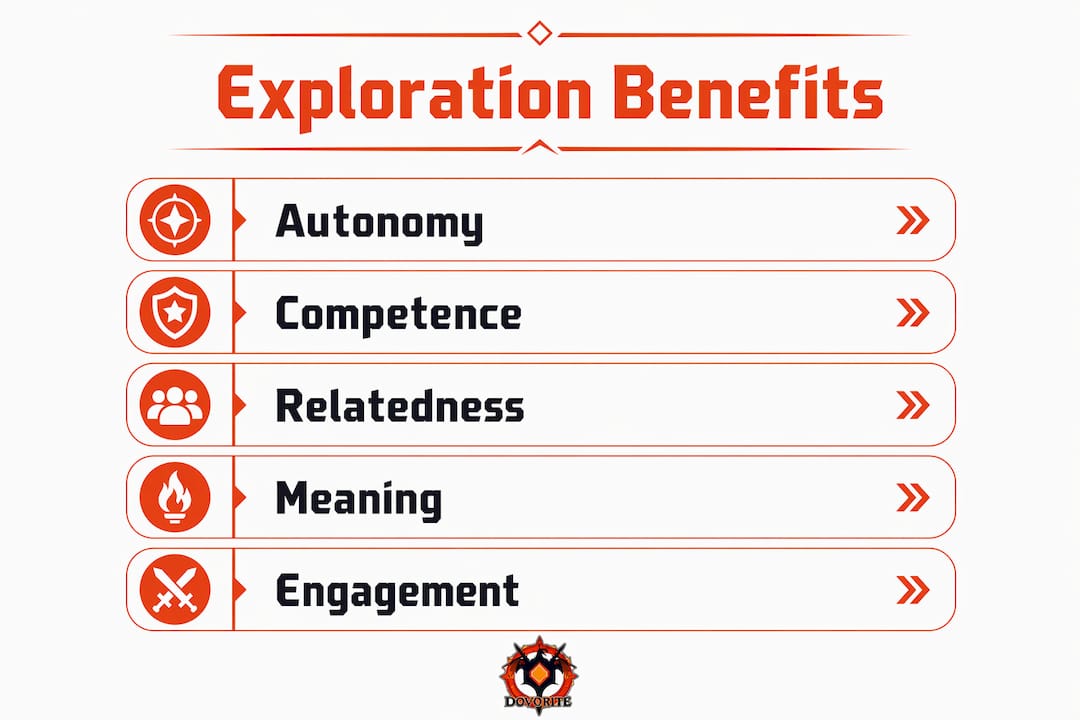
Exploration sustains motivation because it satisfies three psychological needs identified by Self-Determination Theory: autonomy, competence, and meaning. These needs underpin durable motivation in any learning or play context, and text adventures deliver all three through the act of discovery.
Autonomy comes from the open command interface. No button press limits you to four directions. You can attempt to bribe the guard, examine the ceiling, or ask the innkeeper about the war. The game may not support every command, but the feeling of unlimited agency is real and motivating. Competence builds as the player learns which commands the parser accepts, which objects matter, and which narrative threads reward attention. Meaning arrives when a discovered secret reframes the story or when a puzzle solution unlocks a consequence the player did not anticipate.
Player-side interpretation drives exploration in a way that graphical games rarely achieve. In a text adventure, the player is not just reacting to visual cues. They are constructing a mental model of the world, testing it with commands, and revising it based on responses. That internal reasoning process is a form of engagement that keeps players invested long after the novelty of the interface fades.
Design that signals unexplored territory and delivers scaled rewards for persistence increases player motivation to continue. A door described as “heavy and old, with a keyhole you haven’t found a key for” is more motivating than a locked door with no description. The promise of discovery is itself a reward.
Key motivational drivers in text adventure exploration:
- Autonomy: Open command input creates the perception of unlimited agency.
- Competence: Mastering parser logic and world rules builds player confidence.
- Meaning: Discovered secrets and narrative consequences make choices feel significant.
- Reward signaling: Descriptions that hint at unexplored content sustain persistence.
- Hypothesis testing: The mental cycle of propose, test, and revise keeps cognition active.
“Exploration shifts where meaning is produced toward the player’s internal hypothesis testing, making discovery a mental and narrative engagement process.” — On puzzles in interactive fiction
This shift in meaning-making is what separates text adventure engagement from passive entertainment. The player is not an audience. They are a co-author of the experience.
How exploration enhances storytelling in text adventures
Text’s greatest advantage over graphical formats is that exploration-triggered consequences can be richly described without requiring new visual assets. A village that thrives after the player’s intervention, a sky that changes color when a curse is lifted, a character whose tone shifts after a secret is revealed. All of these are free in text. In a graphical game, each requires art, animation, and rendering budget.
This means designers can treat exploration as a direct narrative instrument. Every room the player enters, every object they examine, every NPC they question is an opportunity to add a layer to the story. The world does not just respond mechanically. It responds narratively, and that response is shaped by what the player chose to explore. Exploration as a narrative instrument edits the story fabric dynamically, making each playthrough feel authored for that specific player.
The table below contrasts how exploration functions in text adventures versus graphical games across four dimensions that matter most to designers and players.
| Dimension | Text adventure | Graphical game |
|---|---|---|
| World state changes | Described in unlimited detail via prose | Constrained by art and animation budget |
| Player agency | Open command input, hypothesis-driven | Limited to designed interaction points |
| Narrative feedback | Immediate, text-based, infinitely variable | Requires scripted cutscenes or dialogue trees |
| Imagination engagement | Player constructs mental imagery | Visual assets define the world |
The text format’s flexibility means that replay value in text RPGs is structurally higher than in graphical games. A different sequence of exploration choices produces a genuinely different narrative experience, not just a different score.
Practical design considerations for exploration in text adventures
Building exploration that feels fair and rewarding requires discipline at the technical and narrative levels. The most common failure mode is a parser that punishes players for reasonable commands because the designer did not anticipate them. Layered visibility algorithms and scope checks prevent inconsistent or failed player commands during exploration, and they are non-negotiable in any serious text adventure design.
Stateful exposure is the second pillar of good exploration design. Unlocking new areas or interactions only after specific player actions structures discovery so that progress feels earned rather than arbitrary. A door that opens after the player finds the key is satisfying. A door that opens because the player happened to walk past it three times is not. Stateful gates give exploration a logical grammar that players can learn and trust.
Two-phase command validation and behavior attachments support complex exploration interactions such as locked doors, NPC trades, and conditional puzzle states. The first phase checks whether the command is syntactically valid and the object is in scope. The second phase checks whether the current world state permits the action. This architecture keeps exploration mechanics modular, so designers can add new interactions without breaking existing ones.
Practical design principles for exploration:
- Scope consistency: Every object mentioned in a room description must be interactable. If the player can see it, they should be able to examine it.
- Stateful gating: Use world state changes to structure discovery. New areas and interactions should unlock through player action, not random chance.
- Reward signaling: Describe unexplored content in ways that promise future payoff. Curiosity is a renewable resource if you feed it correctly.
- Parser transparency: When a command fails, tell the player why in a way that guides their next attempt without giving the answer away.
Pro Tip: Test your parser with players who have never seen the game. Their failed commands are your design checklist. Every “I don’t understand that” response is a missed opportunity to deepen exploration.
Structuring exploration-driven quests around these principles produces adventures where players feel genuinely clever rather than arbitrarily blocked. That distinction is the difference between a game players finish and one they abandon at the second puzzle.
Key takeaways
Exploration drives text adventure games because it delivers autonomy, competence, and meaning through a continuous cycle of player-directed discovery and narrative response.
| Point | Details |
|---|---|
| Exploration is the core mechanic | Parser-based command input creates an expanding possibility space that rewards curiosity and persistence. |
| Psychology sustains motivation | Self-Determination Theory confirms that autonomy, competence, and meaning keep players intrinsically engaged. |
| Text format amplifies narrative | World state changes can be described in unlimited prose detail, giving exploration direct narrative power. |
| Fair design requires scope management | Layered visibility and stateful gating keep exploration consistent, trustworthy, and satisfying. |
| Reward signaling drives persistence | Descriptions that promise unexplored content motivate players to push through difficulty. |
Exploration is the design decision that defines everything else
I have spent years watching designers treat exploration as a feature to add after the story is written. That is the wrong order. In text adventures, exploration is the story delivery mechanism. Every room description, every parser response, every locked door is a narrative beat. When you design the exploration first, the story follows naturally from the world you build. When you design the story first and bolt exploration on top, players feel the seams.
The arrival of AI-driven text engines has made this more urgent, not less. Tools like AI Dungeon and the architecture behind platforms like Dovorite have expanded what exploration can mean in interactive fiction. A generative world can respond to commands no designer anticipated. That is extraordinary. But it also means the psychological principles matter more than ever. If the world responds to everything but means nothing, players disengage faster than they would in a tightly authored parser game. Autonomy without consequence is just noise.
My honest advice to designers: read the player engagement research on text RPG writing and then go play Zork for two hours. The gap between what you thought exploration meant and what it actually does to a player is the most useful design education you can get. The text adventure format has survived fifty years because exploration done right is one of the most compelling experiences in gaming. Protect that.
— Corban
Experience exploration-driven text adventures on Dovorite
Dovorite Chronicles is built on the principle that exploration should feel personal, consequential, and narratively alive. Every story on the platform responds to your choices with the kind of prose detail that graphical games cannot match. Whether you are uncovering the political conspiracy in The Dragon Crown Conspiracy or solving the mysteries of The Glass Gardens of Elysium, the world changes based on what you choose to investigate.

Dovorite combines strategic dice mechanics with dynamic storytelling so that exploration carries real stakes. You are not reading a fixed narrative. You are building one through discovery. Start your adventure at Dovorite Chronicles and find out what the format can do when exploration is the design priority from the first line of the world.
FAQ
What makes exploration different in text adventures vs. graphical games?
Text adventures use open command input so players propose any action rather than selecting from a fixed menu. This creates a hypothesis-driven discovery loop that graphical games, constrained by visual assets and scripted interactions, cannot replicate at the same depth.
How does exploration support player motivation in interactive fiction?
Exploration satisfies autonomy, competence, and meaning, the three psychological needs Self-Determination Theory identifies as the foundation of intrinsic motivation. Players who direct their own discovery and master a game’s systems stay engaged far longer than those following a linear path.
Why do text adventure designers need to manage parser scope carefully?
Scope management determines whether a player’s reasonable command succeeds or fails. Visibility and scope algorithms align what the player perceives with what the parser accepts, preventing the frustration that breaks trust and ends play sessions.
What is stateful exposure in text adventure design?
Stateful exposure means new areas or interactions unlock only after specific player actions, structuring discovery so progress feels logical and earned. It is the mechanism that turns exploration from random wandering into purposeful investigation.
How does exploration enhance storytelling in the text format specifically?
Text can describe world state changes in unlimited prose detail the moment an exploration action triggers them, without any art or animation cost. This makes exploration a direct narrative tool, where every discovery the player makes can immediately reshape the story they are experiencing.