
How Playable Novels Build Unique Sagas for Gamers

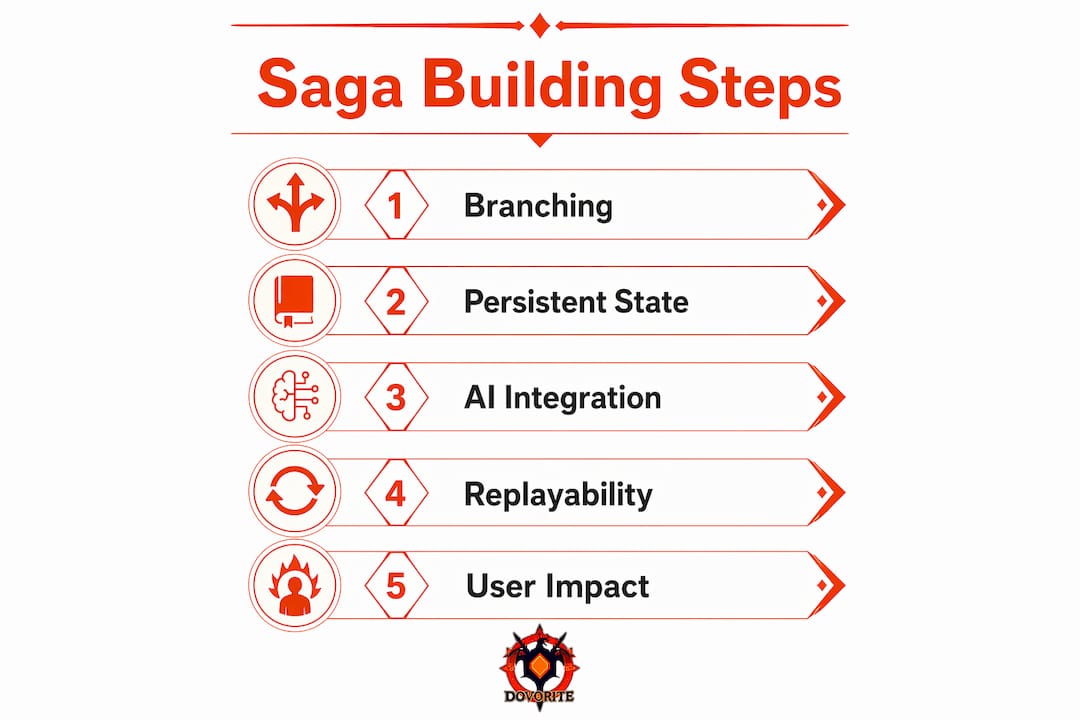
A playable novel is an interactive narrative format where your choices directly determine which story path unfolds next, creating a saga that belongs only to you. Unlike traditional fiction, these works use branching sections of text where each decision routes you to a different segment, building a completely different story from the one your friend experienced. Platforms like Dovorite and systems like Saga & Seeker have pushed this format far beyond the Choose Your Own Adventure paperbacks of the 1980s. Understanding how playable novels build unique sagas means understanding three interlocking systems: branching structure, persistent narrative state, and AI-driven narration.
How do branching narrative structures in playable novels create diverse storylines?
Branching structure is the core mechanic that makes every playable saga different. Gamebooks range from branching-plot novels to full adventure gamebooks with dice mechanics, but all of them share one design principle: numbered or segmented text sections that redirect based on reader choice. Turn left at the crossroads and you read section 47. Turn right and you read section 112. Two readers, two completely different stories.
The depth of that divergence depends on how the branches are designed. Shallow branching gives you the illusion of choice but funnels everyone back to the same major plot beats. Deep branching creates genuinely different story arcs, different allies, different endings. The best saga-style playable novels use a mix of both. Minor choices create texture and personalization. Major choices reshape the story’s direction entirely.
Here is what separates a forgettable branching story from a genuinely unique saga:
- Meaningful consequences: Each choice must visibly change something. If choosing to spare an enemy has no effect three chapters later, the choice felt hollow.
- Variable character relationships: Who trusts you, who fears you, and who owes you a debt should shift based on your decisions.
- Multiple endings with different emotional tones: Not just “good ending” vs. “bad ending,” but endings that feel earned by the specific path you walked.
- Convergence points: Moments where divergent paths meet again, but with different context depending on your history.
Pro Tip: Design your major branch points around character values, not just tactical decisions. A reader who consistently chooses mercy over force should arrive at a different saga than one who chose power. Value-based branching creates the most memorable and personal stories.
The Choose Your Own Adventure series proved that even simple branching could hook millions of readers. Modern saga-style playable novels build on that foundation with far more structural sophistication, tracking not just where you go but who you become along the way.

What role does persistent narrative state play in building a unique saga?
Branching structure creates divergence. Persistent narrative state is what makes that divergence mean something across an entire saga. Without it, each episode starts fresh and your choices evaporate. With it, the story remembers you.
Questas’ living canon method separates narrative facts into two categories. Immutable facts are the fixed truths of the world: the kingdom’s history, the laws of magic, the names of the gods. Branch-conditional facts are truths that depend on your choices: whether you saved the merchant, whether you revealed your identity to the council, whether the rebellion succeeded. Both types must be tracked and respected for a saga to feel coherent.
| State model | How it works | Best for |
|---|---|---|
| Static world state | Fixed facts only, no player influence | Linear novels with light interactivity |
| Simple flag tracking | Binary on/off switches for key choices | Short gamebooks with limited replay depth |
| Living canon | Layered immutable and conditional facts with series-level signals | Multi-episode sagas with deep replayability |
| AI world-state engine | Structured knowledge extracted from narrative transcripts with schema-defined memory | Long-form AI-driven interactive stories |
The living canon approach uses series-level signals, essentially flags that represent the most consequential decisions you made. Did you side with the crown or the rebels? Did you sacrifice your mentor? These signals ripple forward through every subsequent episode, shaping dialogue, available quests, and even which characters are still alive.
A stateful narrative model that tracks a canonical world model and uses reconciliation prevents the most common saga-breaking problem: contradiction. Nothing destroys immersion faster than a character referencing an event that never happened in your playthrough, or forgetting a sacrifice you made three episodes ago.
Pro Tip: Build your canon hub before you write a single scene. List your immutable world facts first, then map out which player decisions will create conditional facts. This architecture prevents contradictions before they happen and makes your saga far easier to extend.
How does AI enhance dynamic, unique sagas in playable novels?
AI has changed what is structurally possible in interactive storytelling. Traditional branching requires authors to pre-write every path. AI narration generates responses dynamically, which means the story can respond to inputs no author anticipated.
SEELE’s AI-powered platform generates branching narratives where NPC dialogue adapts based on player choices and maintains story logic through multiple validation layers. That last part is critical. Generating text is easy. Generating text that stays consistent with 40 prior decisions is the hard problem AI systems are now solving.
Saga & Seeker replaces rigid multiple-choice with free-form player input, letting you type what your character actually says or does rather than selecting from a preset list. The result feels closer to a tabletop RPG session than a traditional gamebook. You are not choosing from options A, B, or C. You are writing your character’s actions in natural language and watching the story respond.
The key capabilities that make AI-driven sagas work:
- Fact-checking against established canon: The AI validates each generated story beat against the world state before presenting it to the player.
- Constraint satisfaction: Story logic rules prevent the AI from generating outcomes that contradict prior choices or world facts.
- Dynamic NPC memory: Characters remember your history with them and respond accordingly, not just in the current scene but across sessions.
- World-state validation: AI-generated content is checked against established canon and story constraints before delivery, preventing contradictions at the generation stage.
The practical result for readers and gamers is a saga that feels genuinely responsive. Your character’s reputation, alliances, and past decisions shape every new scene in ways that a static branching tree simply cannot replicate.
What are the best practices for crafting immersive, replayable sagas?
Knowing the mechanics is one thing. Building a saga that actually works at scale requires discipline in how you design and manage complexity. The single biggest mistake new interactive authors make is trying to track everything.
Questas emphasizes tracking a small set of narrative signals that affect many outcomes rather than logging every micro-choice. This approach avoids combinatorial explosion, the point where the number of possible story states becomes impossible to write for or test. Five powerful signals that each influence dozens of scenes produce richer sagas than fifty minor flags that each affect one line of dialogue.
Here are the most common pitfalls in saga design and how to avoid them:
- Tracking too many variables. Focus on relationship flags and major story signals. Canon shaping with a few powerful narrative variables drives far more meaningful variation than exhaustive micro-tracking.
- Forgetting convergence points. Long sagas need moments where divergent histories are acknowledged and reconciled. A soft recap, where the story briefly reflects your past choices, keeps readers oriented without breaking immersion.
- Ignoring authoring tools. Flowchart management and section numbering are not optional for complex branching narratives. Without visual tools, you will create contradictions you cannot find and paths that dead-end without warning.
- Writing branches in isolation. Each branch must be tested against every canon state that could lead to it. A scene written for a player who betrayed the guild must still make sense if that player also lost their mentor.
- Neglecting replayability anchors. Designing around variables and anchors rather than one-off choices lets outcomes echo across episodes, making the saga feel unique yet internally consistent on a second or third playthrough.
The structural goal is a saga where every reader can point to three or four moments that feel personally theirs. Those moments are the product of well-designed signals, not exhaustive branching.
Key Takeaways
Playable novels build unique sagas by combining branching narrative structures with persistent state tracking and AI-driven narration that keeps every choice meaningful across an entire series.
| Point | Details |
|---|---|
| Branching structure drives divergence | Numbered or segmented text sections route readers to different story paths based on their choices. |
| Persistent state makes choices matter | Separating immutable world facts from branch-conditional facts prevents contradictions and keeps sagas coherent. |
| AI enables free-form input | Systems like Saga & Seeker replace preset choices with natural language input, creating genuinely responsive sagas. |
| Track signals, not every choice | A small set of powerful narrative flags produces richer variation than exhaustive micro-choice logging. |
| Authoring tools are non-negotiable | Flowcharts and section numbering keep complex branching narratives editable and consistent at scale. |
Why the best playable sagas are harder to build than they look
I have spent years reading and analyzing interactive fiction, and the gap between a playable novel that feels alive and one that feels like a glorified quiz is almost always invisible to the reader. That is the point. When Questas’ living canon approach works, you never notice the architecture holding it together. You just feel like the story knows you.
The counterintuitive truth about crafting immersive narratives is that more choices do not automatically mean a better saga. The most memorable interactive stories I have encountered track fewer decisions than you would expect. They track the right decisions. A single choice about whether to trust a character early in the story, tracked faithfully across six episodes, creates more emotional weight than a hundred cosmetic decisions about what your character wears.
AI changes the ceiling of what is possible, but it does not change the craft requirement. The writers behind SEELE and Saga & Seeker still need to define the world state, establish the canon constraints, and decide which signals matter. The AI executes within that framework. Readers and gamers who want to explore playable novels are not just consuming a story. They are co-authoring one, and the best platforms are built to honor that collaboration.
The future of saga-style interactive fiction belongs to creators who understand both the narrative craft and the systems design. Those two disciplines used to live in separate industries. Playable novels are where they finally meet.
— Corban
Dovorite Chronicles: where your saga takes shape
Dovorite brings together AI-driven narration, branching story architecture, and living canon mechanics in one platform built specifically for readers and gamers who want more than a passive story.

Dovorite Chronicles offers open-ended story creation where your choices shape a saga that no other player will experience exactly the same way. Stories like Blood Moon Rising and The Dragon Crown Conspiracy put the full weight of branching narrative design behind every decision you make. The platform runs on PC and Mac, and the Dovorite Chronicles experience is built around the principle that every choice matters. Your saga is waiting.
FAQ
What is a saga-style playable novel?
A saga-style playable novel is an interactive fiction format where player choices accumulate across multiple episodes, building a personalized story arc with persistent consequences. Unlike single-session gamebooks, saga-style formats track narrative state so your decisions shape future chapters.
How do playable novels keep track of player choices?
Playable novels use narrative state systems that separate fixed world facts from branch-conditional facts tied to specific player decisions. Advanced platforms use series-level signals, or flags, to track the most consequential choices without creating unmanageable complexity.
What makes AI-powered playable novels different from traditional gamebooks?
AI-powered systems like Saga & Seeker accept free-form natural language input instead of preset multiple-choice options, generating story responses dynamically. They also validate generated content against established canon to prevent contradictions across long play sessions.
How do authors avoid contradictions in long branching sagas?
Authors use a canon hub that lists immutable world facts alongside branch-conditional facts, then test each scene against every possible narrative state that could lead to it. Flowchart tools and section numbering are standard practice for managing this complexity.
What is the biggest mistake in designing a playable saga?
Tracking too many minor choices creates combinatorial explosion, where the number of possible story states becomes impossible to write for consistently. Effective saga design focuses on a small set of powerful narrative signals that each influence many outcomes across the story.