
How to Interpret Ambiguous Story Prompts in RPGs
Interpreting ambiguous story prompts in RPGs means converting vague or open-ended cues into rich, interactive narratives that drive real player engagement. Game masters and players face this challenge constantly, whether they are running Dungeons & Dragons, an OSR campaign, or a solo adventure. Tools like the Loremaster’s Deck and structured prompt frameworks have changed how storytellers handle unclear narrative cues. The methods covered here apply to both tabletop sessions and AI-assisted play, giving you a repeatable system for turning any vague prompt into a playable scene.
How do you interpret ambiguous story prompts in RPG sessions?
The core skill in story prompt interpretation is converting openness into direction without killing creative possibility. A prompt like “the village has a dark secret” gives you almost nothing to work with until you assign it a perspective, a tone, and a set of constraints. Explicit constraints in prompts consistently produce more coherent narratives by limiting vague intent. That means defining role, genre, point of view, tone, and negative constraints before you start building the scene.
The most effective starting point is character motivation. Ask what your protagonist wants, what stands in the way, and what the cost of failure looks like. This three-part frame gives any vague prompt a spine. Defining what “done” looks like and establishing stakes upfront improves both prompt clarity and story coherence. Pixar uses this principle in every story room: know your ending before you write your opening scene.

Named entities matter here. When you replace “a mysterious figure” with “a disgraced cartographer named Vael who knows where the treaty was buried,” the prompt stops being ambiguous. Specificity at the character level cascades into specificity at the scene level. The prompt does not become restrictive. It becomes generative.
What tools support effective RPG prompt interpretation?
Several tools exist specifically for the challenge of unclear story prompts, and they fall into two categories: physical modular decks and digital narrative frameworks.
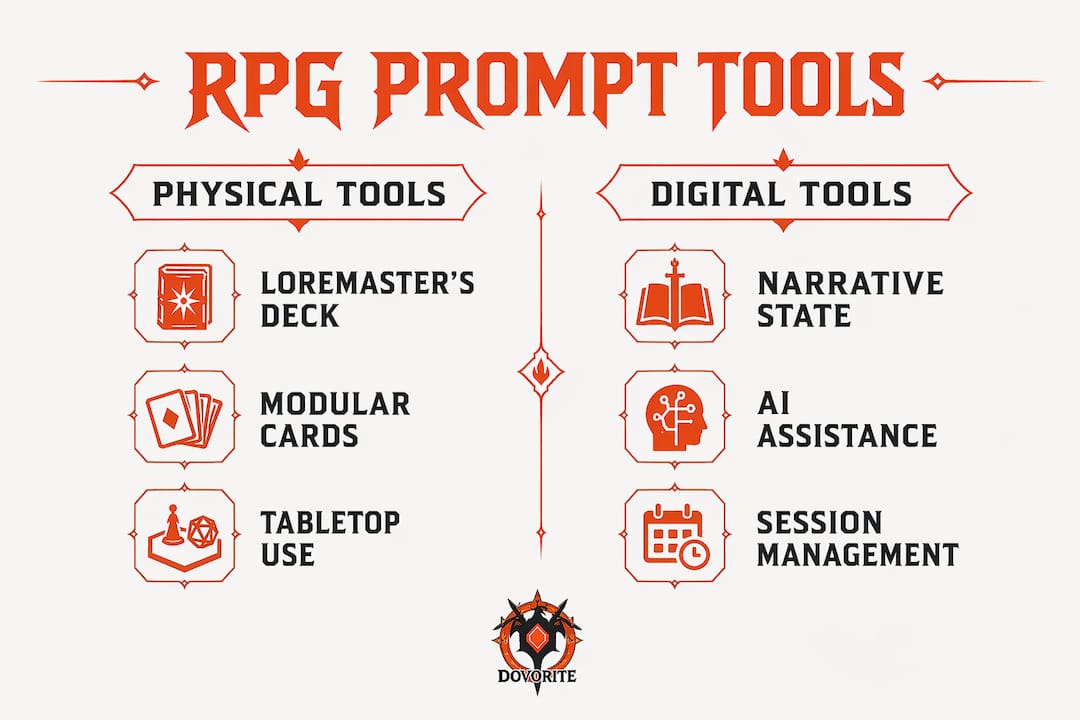
The Loremaster’s Deck is the most widely reviewed modular tool for tabletop use. No two card draws produce the same narrative seed, making it ideal for improvisational game masters running everything from D&D to OSR systems. The deck works by presenting conceptual motifs, symbols, and mysteries that players interpret together, which distributes the cognitive load of meaning-making across the table. You can read a full breakdown of how it works in this Loremaster’s Deck review.
For digital and AI-assisted play, narrative state management is the equivalent tool. This approach involves generating a scene, extracting the key entities and relationships from it, updating a running story state document, and reinserting that summary into the next prompt. Structured narrative state approaches reduce story incoherence by up to 90% in AI-generated sessions. That number reflects how much context loss drives plot contradictions in longer campaigns.
| Tool | Best for | Key feature |
|---|---|---|
| Loremaster’s Deck | Tabletop, group play | Modular motif cards, replayable draws |
| Narrative state doc | AI-assisted, solo play | Entity tracking, continuity management |
| Emulators (e.g., Mythic GME) | Solo tabletop | Yes/no oracle, scene randomizer |
| Meaning tables | Solo or prep work | Thematic word association, tone setting |
Pro Tip: Build a one-page narrative state sheet before each session. List active characters, unresolved threads, and the current thematic question. Update it after every major scene. This single habit prevents the most common form of prompt drift.
How to apply a structured framework to develop story prompts
A repeatable workflow removes the paralysis that comes with a blank or vague prompt. The steps below apply whether you are a game master prepping a session or a player working through a solo adventure.
- Assign a perspective. Decide whose point of view anchors the scene. First person, third limited, and omniscient each produce different narrative textures from the same prompt.
- Set the tone and genre constraints. A prompt about “a city under siege” reads differently in grimdark fantasy versus swashbuckling adventure. Name the tone before you build the scene.
- Extract the core conflict. Every ambiguous prompt contains at least one implied tension. Surface it explicitly. “A city under siege” implies defenders, attackers, and civilians with competing loyalties.
- Define the stakes. Giving stakes upfront improves narrative coherence. What does the player lose if this scene goes wrong? What do they gain if it goes right?
- Add one named entity. Replace one generic element with a specific name, place, or object. This single change makes the prompt feel real.
- Set a negative constraint. Decide what the scene is not. “This is not a combat scene” or “the villain does not appear directly” focuses the narrative without restricting player choice.
- Iterate based on output. Run the scene, then adjust your constraints for the next prompt based on what worked and what felt flat.
More detail in prompts counteracts choice paralysis and enhances thematic impact. That is the counterintuitive truth about creative RPG storytelling: structure does not limit imagination. It focuses it.
Pro Tip: When a prompt feels too open, ask one question before building the scene: “What does the player care about most right now?” Anchor the ambiguous element to that care, and the scene writes itself.
Common mistakes when working with unclear story prompts
The two failure modes in role-playing game story guidance are opposite but equally damaging. Prompts that are too vague produce incoherent scenes with no dramatic tension. Prompts that are too detailed remove player agency and turn the session into a railroad. Maintaining balance between freedom and structure is the critical skill that separates experienced game masters from struggling ones.
Common mistakes and how to fix them:
- Ignoring player input. The table generates meaning collectively. A game master who interprets every prompt alone misses the creative energy in the room. Collaborative interpretation reduces cognitive load and produces richer outcomes.
- Losing thematic coherence. When each session introduces new unresolved threads without closing old ones, players disengage. Track your active themes the same way you track hit points.
- Over-specifying too early. Locking down every detail in a prompt before players engage removes the discovery that makes RPGs compelling. Leave at least one open question per scene.
- Skipping the stakes. A scene without consequences is a scene without tension. Name what is at risk before the first die rolls.
- Treating the first interpretation as final. Ambiguous prompts reward iteration. Run the scene, gather feedback, and refine the next prompt based on what landed.
For mystery-driven campaigns, building character relationships before constructing clue chains produces stronger player emotional engagement than mechanical puzzle design. Players solve mysteries they care about. They abandon mysteries that feel like logic puzzles.
Pro Tip: After each session, ask two players what moment surprised them most. Their answers reveal which ambiguous elements generated genuine engagement. Use those elements as seeds for the next session’s prompts.
How does prompt interpretation differ in solo vs. multiplayer RPGs?
Solo and multiplayer RPGs require different interpretive approaches because the source of meaning-making changes. In multiplayer sessions, the table shares the work. In solo play, the player carries it alone.
Solo RPG tools like emulators and meaning tables simulate the collaborative interpretation that a group provides naturally. Mythic Game Master Emulator uses a yes/no oracle and scene randomizer to answer questions the solo player cannot answer for themselves. Meaning tables generate thematic word associations that push the narrative in unexpected directions without requiring another person at the table.
| Setting | Primary challenge | Best tool | Key technique |
|---|---|---|---|
| Solo play | No external input | Mythic GME, meaning tables | Oracle questions, theater of the mind |
| Small group (2–3) | Uneven contribution | Loremaster’s Deck | Shared card draws, rotating narration |
| Full table (4+) | Competing interpretations | Structured prompt framework | Defined constraints, GM as arbiter |
| AI-assisted | Context loss over time | Narrative state document | Entity extraction, summary reinsertion |
Multiplayer sessions benefit from collaborative narrative evolution because each player brings a different interpretive lens to the same prompt. A prompt about “a burning library” means something different to the party’s scholar than to its arsonist. That tension is the story. The game master’s job is to hold the frame while players fill it.
Examples of ambiguous prompt interpretation in RPG storytelling tools
The Loremaster’s Deck demonstrates how ambiguous narrative techniques work in practice. A draw might produce three cards: “betrayal,” “hidden passage,” and “a debt unpaid.” None of these cards tells you what happens. All three tell you what the scene is about. The game master’s job is to connect them through the lens of the current campaign’s active characters and unresolved threads.
A sample narrative state update looks like this. The previous scene established that the party’s contact, Mira, went missing near the docks. The current prompt is “an unexpected ally appears.” Without a narrative state document, this prompt is wide open. With one, the game master knows Mira’s last known location, her relationship to the party’s rogue, and the faction that wants her silenced. The “unexpected ally” becomes Mira’s estranged brother, who has been tracking the same faction for different reasons. The ambiguity collapses into a specific, emotionally resonant scene.
Ambiguity adds replayability because the same prompt produces different scenes depending on the narrative state at the time of interpretation. This is why experienced game masters treat vague prompts as assets rather than problems.
Tips drawn from these examples:
- Always connect a new prompt to at least one existing unresolved thread.
- Name the emotional stakes before the physical ones.
- Use the text RPG writing practices developed for collaborative digital play to sharpen your scene framing.
- Treat each ambiguous element as a question the players will answer through their choices.
- Revisit unused prompt elements in later sessions. Nothing is wasted in a living campaign.
Key takeaways
Ambiguous story prompts become playable when you apply explicit constraints, name the stakes, and track narrative state across sessions.
| Point | Details |
|---|---|
| Constraints drive coherence | Define role, tone, and negative constraints before building any scene from a vague prompt. |
| Collaborative tools reduce load | Tools like the Loremaster’s Deck distribute meaning-making across the table, producing richer outcomes. |
| Narrative state prevents drift | Tracking entities and unresolved threads between sessions stops plot contradictions from breaking immersion. |
| Solo play needs substitute input | Emulators and meaning tables replace the collaborative interpretation that a group provides naturally. |
| Iteration beats perfection | Run the scene, gather player feedback, and refine the next prompt based on what generated real engagement. |
Ambiguity is the feature, not the bug
I spent years treating vague prompts as failures of preparation. If a session started with an unclear hook, I assumed I had not done enough work beforehand. That assumption was wrong, and it cost me some genuinely interesting campaigns.
The shift happened when I stopped trying to resolve ambiguity before the session and started treating it as raw material for the table to shape together. A prompt like “something is wrong with the harvest” is not a problem. It is an invitation. The players will tell you what is wrong with the harvest through their characters’ fears, histories, and assumptions. Your job is to listen and build from what they give you.
Cyclical campaign designs that distinguish player-facing goals from world-facing phenomena create exactly this kind of productive ambiguity. The players think they are solving a local problem. The world is running a deeper pattern they have not yet recognized. That gap between what players believe and what is actually true is where the best RPG stories live.
The tools covered here, from the Loremaster’s Deck to narrative state documents, are not substitutes for creative instinct. They are scaffolding that lets your instinct operate at a higher level. Use them to set the frame, then trust the table to fill it.
— Corban
Live the story you have been building toward
Dovorite Chronicles puts every technique covered here into practice inside a fully playable fantasy adventure. Every choice you make shapes the narrative, and every ambiguous moment becomes a branch point that leads somewhere genuinely different.

If you want to see how structured prompt interpretation and player agency combine in a live narrative, start your adventure at Dovorite. The Dragon Crown Conspiracy and Blood Moon Rising both demonstrate how ambiguous story seeds grow into campaigns worth finishing. For a hands-on introduction to how the system works, the Dovorite tutorial walks you through the core mechanics in under twenty minutes.
FAQ
What does it mean to interpret an ambiguous RPG prompt?
Interpreting an ambiguous RPG prompt means applying constraints like perspective, tone, and stakes to convert a vague narrative cue into a specific, playable scene. The goal is direction without over-specification.
What is the best tool for interpreting unclear story prompts at the table?
The Loremaster’s Deck is the most widely used modular tool for tabletop prompt interpretation. It presents conceptual motifs that players interpret collectively, reducing cognitive load on the game master.
How do I maintain narrative continuity when prompts are vague?
Use a narrative state document that tracks active characters, unresolved threads, and the current thematic question. Update it after every major scene to prevent plot contradictions across sessions.
Does adding more detail to a prompt limit creative freedom?
No. More detail in prompts counteracts choice paralysis and enhances thematic impact. Structure focuses creativity rather than restricting it.
How does solo RPG prompt interpretation differ from group play?
Solo players use emulators like Mythic Game Master Emulator and meaning tables to simulate the collaborative interpretation a group provides. These tools generate unexpected narrative directions without requiring another player at the table.