
Why World Simulation Matters in Text RPGs

World simulation is the dynamic system that transforms text RPGs from static branching stories into living, reactive game worlds where every player choice leaves a permanent mark. Unlike traditional choose-your-own-adventure formats, simulated worlds track persistent states, evolving NPC relationships, and cascading consequences across entire campaigns. Platforms like Questsmith and TaleWeaver have pushed this technology forward significantly, and the gap between a simulated world and a scripted one now defines the difference between a forgettable session and a story you remember for years. Understanding why world simulation matters in text RPGs means understanding what makes a game world feel genuinely alive.
Why world simulation matters in text RPGs: the core difference
World simulation transforms text RPGs from static choose-your-own-adventure trees into dynamic ecosystems with persistent consequences. Player actions trigger socio-economic ripple effects that the AI maintains without pre-programming every possible outcome. That distinction is enormous. In a scripted game, burning down a tavern leads to a pre-written cutscene. In a simulated world, the tavern’s destruction raises local ale prices, displaces the innkeeper, and makes a rival merchant wealthier. None of that required a developer to write it.

Traditional text RPGs relied on branching path architecture. Every outcome was authored in advance, which capped the depth of any story at the limits of the writer’s foresight. World simulation replaces that ceiling with a rules-based engine that generates consequences from first principles. The result is a game world that behaves consistently whether or not the designers anticipated your specific action.
This shift also changes what “game world realism” means. Realism in a simulated text RPG is not about photorealistic graphics. It is about whether the world remembers what you did and responds accordingly. That is the standard modern players now expect, and it is the standard that separates serious text-based game design from casual interactive fiction.
How world simulation changes text RPG mechanics
The mechanical difference between classic branching games and AI-driven world simulation comes down to one concept: state management. In a traditional text RPG, the game tracks a handful of binary flags. You either rescued the prisoner or you did not. In a simulated world, the game tracks HP, inventory weight, faction reputation, economic conditions, NPC emotional states, and dozens of other variables simultaneously.
Here is how that plays out in practice across the core mechanics:
- Game state management. Every item you pick up, every spell you cast, and every alliance you form updates a persistent world state. Platforms like TaleWeaver use dual-pass architecture where one pass handles mechanical states and another generates narrative prose. This keeps the numbers honest while keeping the story immersive.
- Rule enforcement systems. Consistent rules are what make player choices feel meaningful. If a character with 5 Strength can lift a boulder in one scene but cannot in another, the world loses credibility. Deterministic rule enforcement prevents that inconsistency and builds the trust that keeps players invested across long campaigns.
- Persistent consequences. Actions compound over time. A merchant you cheated in Act 1 may refuse to sell you supplies in Act 3. An understanding of stats in text RPGs shows just how many variables feed into these cascading outcomes.
- Dynamic NPC responses. NPCs do not just react to your last action. They respond based on a full history of interactions, adjusting their tone, their offers, and their willingness to help.
Pro Tip: When evaluating a text RPG platform, test it by doing something unexpected early in the game and then checking whether that action has any downstream effect three sessions later. If it does not, the world is scripted, not simulated.
How AI and memory systems keep text RPG worlds coherent
The biggest technical challenge in world simulation is not generating good prose. It is remembering everything that happened. AI language models have finite context windows, which means long campaigns naturally suffer from context drift. Details from session one fade by session ten, and NPCs start acting like they have never met you.
The solution is structured memory architecture. Questsmith solves this by extracting key facts and surfacing them across sessions to maintain narrative coherence. Rather than feeding the AI a raw transcript of everything that happened, the system pulls out the facts that matter: character relationships, stat changes, major decisions, and world events. This keeps the AI’s working memory clean and accurate even across dozens of sessions.
Lore Books serve a similar function. Think of them as living world encyclopedias that the AI consults before generating any response. They store geography, faction politics, NPC backstories, and established rules. When the AI writes a scene, it checks the Lore Book first, which prevents contradictions and keeps the world internally consistent.
Key capabilities that strong memory architectures provide:
- Fact extraction over raw storage. Storing summaries of important events rather than full transcripts keeps retrieval fast and accurate.
- Event-based ledger systems that replay timeline history to compute world state, avoiding the need to manually update every variable after each action.
- NPC personality persistence. AI uses sentiment analysis and linguistic pattern recognition to simulate traits like pride, vulnerability, and sarcasm consistently across sessions.
- Campaign-scale tracking. Platforms like Questsmith support tracking 500 or more adventure details, including character relationships, stats, and world-altering decisions.
Pro Tip: Before committing to a long campaign on any AI text RPG platform, ask whether it uses a Lore Book or structured memory extraction. Platforms without these systems will lose narrative coherence after a few sessions, no matter how good the prose generation is.
Benefits of world simulation for narrative immersion in RPGs
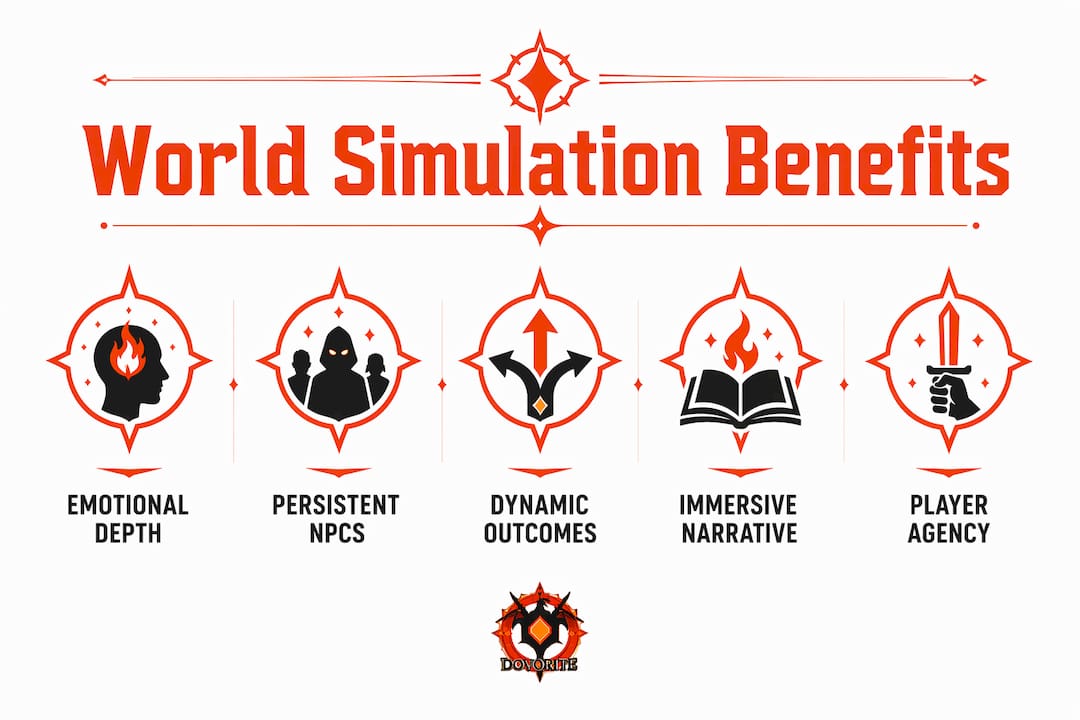
The deepest benefit of world simulation is not mechanical. It is emotional. When an NPC remembers that you saved her village three sessions ago and adjusts her dialog accordingly, the interaction carries weight that no scripted scene can replicate. That weight comes from the player knowing the response was earned, not authored.
Text RPGs have always had one structural advantage over graphical games: the theater of the mind. A written description of a burning city activates imagination in ways that even the best game engine cannot fully match. World simulation amplifies this advantage by making the mental model of the world accurate. You can predict how the world will respond to your actions because the simulation follows consistent rules. That predictability, paradoxically, makes the world feel more alive.
Out-of-Character (OOC) prompts add another layer of control. Players use bracketed OOC instructions to direct the AI’s storytelling logic without breaking immersion. Want to slow down the pacing before a major reveal? Add tension to a negotiation scene? OOC prompts let you act as co-director without stepping outside the story.
The table below shows how AI-driven world simulation compares to traditional text RPG features across the dimensions that matter most for immersion:
| Feature | Traditional text RPG | AI-driven world simulation |
|---|---|---|
| NPC memory | Resets each session | Persists across full campaign |
| Consequence tracking | Pre-scripted outcomes only | Dynamic, cascading effects |
| World state | Binary flags | Multi-variable persistent state |
| Player agency | Limited to authored paths | Open-ended, rules-based responses |
| Narrative coherence | Consistent but static | Consistent and evolving |
Pro Tip: Use OOC prompts strategically at the start of major scenes to set tone and pacing. Treating the AI as a collaborative director rather than a passive narrator produces significantly richer storytelling outcomes.
Challenges and future directions in text RPG world simulation
World simulation at scale is computationally expensive. Tracking hundreds of variables, running sentiment analysis on NPC states, and maintaining a coherent Lore Book across a long campaign requires significant processing power. Most players never see this cost directly, but it shapes which platforms can afford to offer deep simulation and which cannot.
Current limitations and emerging solutions include:
- Computational cost. World models simulate complex environments with 100 to 1000 times efficiency improvements over physics-based solvers, running thousands of simulations on GPUs. This same efficiency logic is being applied to narrative engines, making deep simulation more accessible.
- Balancing freedom with consistency. The more freedom a player has, the harder it is to maintain consistent rule enforcement. The best platforms solve this through event-based ledger architecture that replays timeline history rather than tracking a snapshot of current state.
- Multimodal integration. Text-only simulation is giving way to hybrid experiences that combine prose with generated images and ambient audio. This does not replace the theater-of-the-mind advantage but adds sensory anchors that deepen immersion.
- Anticipatory AI behavior. World models shift AI systems from reacting to anticipating by rehearsing and evaluating consequences before acting. Applied to text RPGs, this means AI gamemasters that can foreshadow events, plant narrative seeds, and build toward climaxes with genuine dramatic intelligence.
- Hybrid narrative engines. Platforms are beginning to combine large language models with structured rule engines, giving players the prose quality of a great novelist alongside the consistency of a tabletop rulebook.
The direction is clear. Text RPG world simulation is moving toward systems that connect sensing and control, allowing AI to understand context and make decisions across tasks and environments far beyond simple text inputs. The genre is not converging with video games. It is becoming something new entirely.
Key takeaways
World simulation is the defining technology separating modern AI-driven text RPGs from their static predecessors, and platforms that invest in persistent state management, structured memory, and dynamic NPC behavior produce measurably richer player experiences.
| Point | Details |
|---|---|
| Simulation vs. scripting | Simulated worlds generate consequences from rules; scripted worlds only deliver pre-authored outcomes. |
| Memory architecture matters | Platforms using Lore Books and fact extraction maintain narrative coherence across long campaigns. |
| NPC depth drives immersion | Persistent NPC personalities with sentiment-aware responses create emotionally earned interactions. |
| OOC prompts expand control | Players can direct pacing and tone without breaking immersion using bracketed out-of-character instructions. |
| Future simulation is anticipatory | Emerging AI world models rehearse consequences before acting, enabling dramatically intelligent gamemasters. |
Why I think most players underestimate world simulation
I have spent a long time watching players evaluate text RPGs almost entirely on prose quality. They read a few paragraphs, decide the writing is good, and commit to a platform. That is the wrong filter. Prose quality is table stakes. What actually determines whether a campaign stays compelling at session 20 is whether the world remembers session 1.
The platforms that invest in structured memory, event ledgers, and rule enforcement are building something qualitatively different from those that just wrap a language model in a fantasy skin. The difference does not show up in a five-minute demo. It shows up when your character’s past choices start shaping present options in ways you did not anticipate. That is when the game stops feeling like a story being told to you and starts feeling like a world you actually inhabit.
My advice to any serious text RPG player: treat world state depth the same way you treat character build depth. Ask hard questions about how the platform tracks consequences. Read about lore management strategies before you start a campaign. The players who do this consistently report the most satisfying long-term experiences. The ones who skip it often abandon campaigns mid-arc because the world stopped making sense.
The genre’s ceiling is not prose. It is simulation fidelity. And we are only beginning to see what that ceiling looks like when you actually reach for it. Explore the multiplayer narrative evolution happening right now to see where the best platforms are heading.
— Corban
Experience world simulation firsthand with Dovorite
Dovorite is built on the principle that you should not just read the story. You should live it. Every adventure on Dovorite Chronicles features an AI gamemaster that tracks persistent world states, remembers your choices across sessions, and drives NPCs with genuine personality depth. Your decisions shape the economy, the politics, and the relationships of a world that keeps evolving whether you are playing or not.

If you want to see what deep world simulation actually feels like in a text RPG, The Living Ink Chronicles at Dovorite’s fantasy adventures is the place to start. Dynamic dice mechanics, branching narrative consequences, and a world that holds your history. This is text RPG design built around simulation fidelity, not just good writing. Your saga is waiting.
FAQ
What is world simulation in a text RPG?
World simulation in a text RPG is a rules-based system that tracks persistent game states, NPC behaviors, and player-driven consequences across an entire campaign. Unlike scripted branching paths, simulated worlds generate outcomes dynamically based on established rules rather than pre-authored responses.
How does AI memory work in text RPG world simulation?
AI memory systems extract key facts from gameplay, such as character stats, relationships, and major decisions, and surface them in future sessions to maintain narrative coherence. Platforms like Questsmith track 500 or more adventure details to prevent context drift across long campaigns.
Why does rule enforcement matter for text RPG immersion?
Consistent rule enforcement makes player choices feel meaningful by ensuring the world responds predictably to actions. When mechanics are deterministic, players trust the simulation and invest more deeply in long-term strategic decisions.
What are OOC prompts and how do they help?
Out-of-Character prompts are bracketed instructions players use to direct the AI’s storytelling logic without stepping outside the narrative. They control pacing, tone, and scene composition, effectively making the player a co-director of the story.
What is the biggest technical challenge in text RPG world simulation?
The primary challenge is maintaining narrative coherence across long sessions as AI context windows have finite capacity. Event-based ledger systems and structured Lore Books solve this by replaying timeline history and surfacing only the most relevant facts rather than storing raw transcripts.