
What Is a Hex Map Text RPG? A Gamer’s Guide
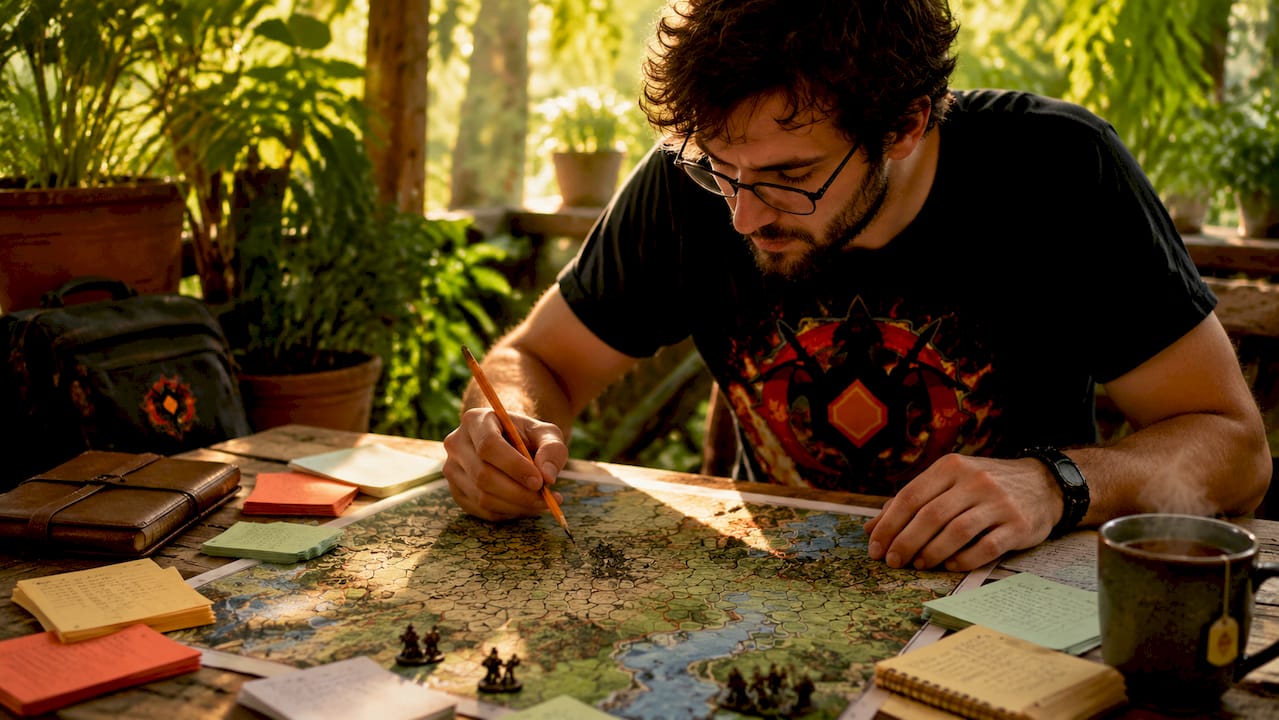
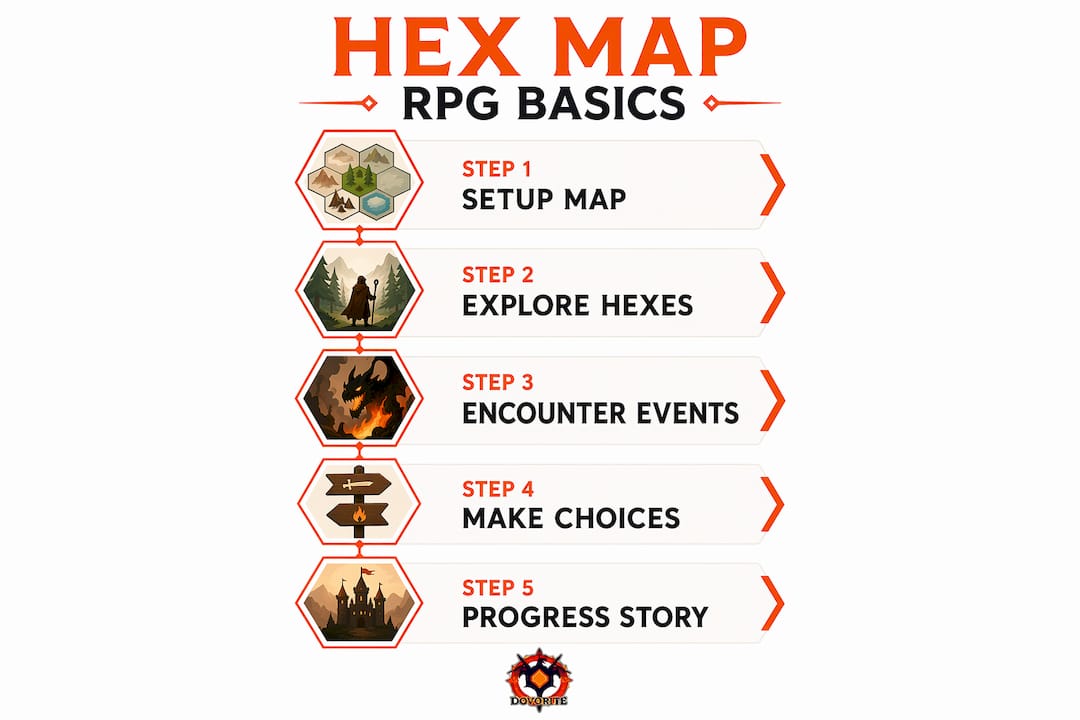
A hex map text RPG is a role-playing game that combines a hexagonal grid map with text-based gameplay to structure exploration, encounters, and narrative choices. This hybrid format draws from classic D&D-style hexcrawls and the branching storytelling of text adventures, producing a game where the map drives discovery and words build the world. You navigate a grid of six-sided tiles, each holding hidden content, while the game describes everything you see, find, and fight. Dovorite captures this same spirit: every choice reshapes your story, and every tile you uncover could change the saga.
What is a hex map text RPG and how does it work?
A hex map text RPG merges two distinct design traditions into one format. The first is the hexagonal grid, a mapping tool borrowed from wargames and tabletop RPGs. The second is the text-based RPG, a game driven entirely by written descriptions, player input, and mechanical prompts rather than graphics.
The hexagonal grid is the structural backbone. Each hex represents a region of the game world, typically containing terrain, encounters, landmarks, or lore. The text interface is the sensory layer. Instead of seeing a forest tile, you read: “Dense pine canopy blocks the midday sun. Something moves in the undergrowth to your east.” Together, these two systems create a game that rewards curiosity and punishes carelessness.
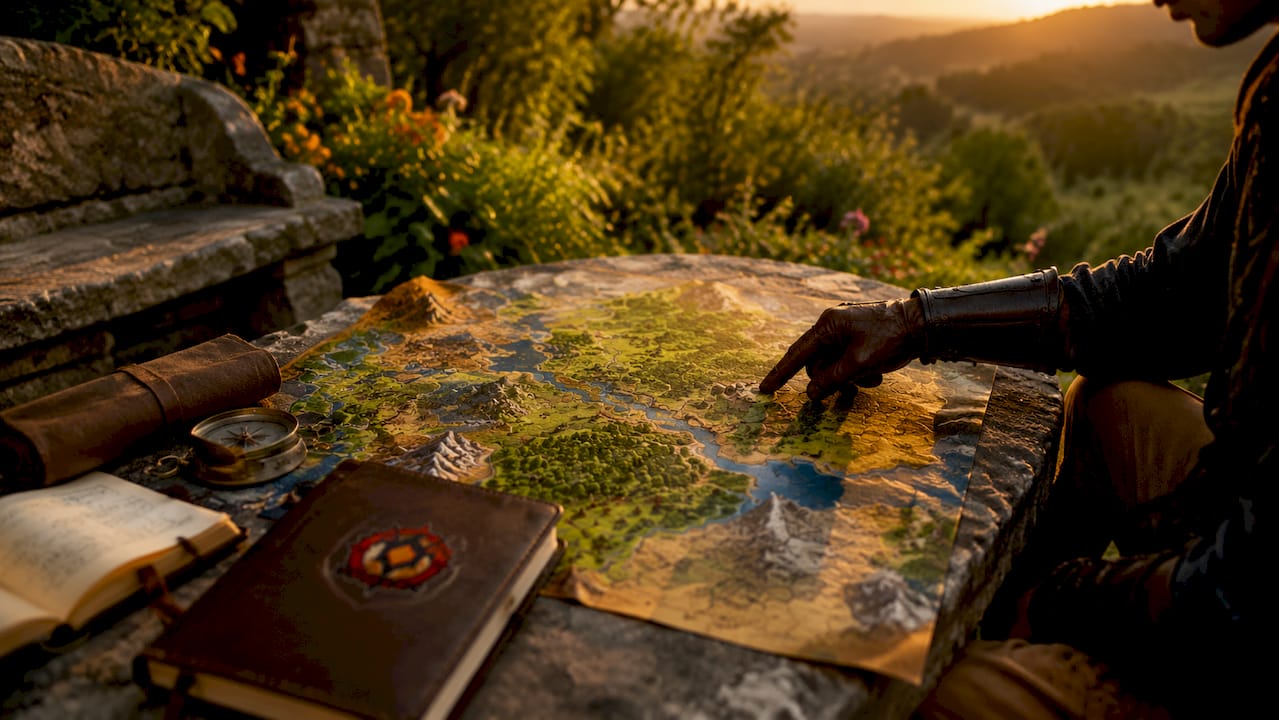
The format sits between a pure text adventure and a full tabletop RPG. It has more structure than a choose-your-own-adventure book, and more narrative freedom than a grid-based video game. If you have played Zork, read a D&D hexcrawl sourcebook, or explored a sandbox text engine, you already understand the ingredients. The hex map text RPG just combines them deliberately.
What role do hex maps play in RPG exploration?
Hex maps solve a specific problem in exploration-focused RPGs: how do you give players genuine freedom without turning the game into chaos? The hexagonal grid provides a spatial framework that feels open but stays manageable.
The geometry matters more than most players realize. All adjacent hexes are equidistant, which eliminates the diagonal movement ambiguity that plagues square grids. In a square grid, moving diagonally covers more ground than moving straight, creating rule disputes and uneven pacing. Hex grids remove that problem entirely. Movement stays consistent, and players can focus on decisions rather than math.
Scale and size also matter for campaign design. A standard D&D hexcrawl uses 6 miles per hex, with parties covering 3–4 hexes per day on foot. A recommended map size runs 40x30 hexes, covering roughly 240x180 miles of wilderness. That scale supports multi-session campaigns without making the world feel either cramped or impossibly vast.
The most important hex map mechanic is keying. Keying attaches specific content to individual hexes, such as encounters, ruins, NPCs, or environmental details. The recommended density is one keyed hex in every three. That ratio keeps exploration interesting without overwhelming the game master or the player.
Pro Tip: Start your hex map with a strong central landmark, then key outward in rings. Players naturally explore from a home base, so you can prepare the nearest ring in detail and leave outer hexes as rough notes until the party gets close.
| Hex Map Feature | Function in Text RPG |
|---|---|
| 6 miles per hex scale | Sets realistic travel time and pacing |
| 40x30 hex map size | Supports long campaigns without world-building overload |
| One keyed hex per three | Balances discovery with breathing room |
| Equidistant adjacency | Removes movement rule disputes |
| Coordinate system (cube/offset) | Keeps navigation accurate across sessions |
How do text-based RPG mechanics work with hex structures?
Text-based RPG mechanics are the engine that makes hex exploration feel alive. Without strong writing and clear mechanical cues, a hex map is just a grid. With them, it becomes a world.
The core mechanics in a text RPG include branched narrative choices, skill checks, inventory management, and turn-based combat. Each of these maps naturally onto hex exploration. Moving into a new hex triggers a description. A skill check might determine whether you notice the hidden cave entrance. Your inventory decides whether you can survive the mountain crossing. Evocative descriptions combined with mechanical cues are what overcome the absence of visuals and build genuine mental imagery.
The Fog of War mechanic is particularly powerful in text-based hex RPGs. Fog of War hides map details until the player explores them, shifting focus from passive map-reading to active discovery. In a graphical game, this is a visual effect. In a text RPG, it works through information control. You only learn a hex’s terrain, name, and contents when your character enters it. That restraint creates suspense and makes every new hex feel like a genuine reveal.
Here is what strong text-based hex RPG mechanics look like in practice:
- Branched choices at hex entry: Each hex presents 2–3 options based on what the player finds, keeping agency high
- Skill checks tied to terrain: A forest hex might require a Survival check; a ruin hex might call for a History roll
- Inventory pressure: Resource management (food, torches, healing items) adds stakes to long exploration chains
- Turn-based combat triggers: Encounters key to specific hexes fire when the player enters, not randomly
- Narrative callbacks: Returning to a previously visited hex reveals changes based on earlier player choices
Pro Tip: Write each hex description in two layers: a surface layer the player reads on entry, and a deeper layer that unlocks after a successful skill check or specific action. This rewards thorough players without punishing casual ones.
Dovorite’s approach to text RPG writing follows this same principle: mechanical clarity and narrative richness reinforce each other rather than compete.
What tools exist for creating hex map text rpgs?
The right tools cut your prep time significantly and let you focus on storytelling rather than logistics. Several dedicated platforms handle the technical side of hex map creation and text RPG hosting.
Hexer (hexermap.com) is purpose-built for D&D-style hexcrawl maps. It handles scaling, keying, and export. Text Mapper generates procedural hex maps from simple text input, making it fast for GMs who want a quick wilderness layout. LegendKeeper combines world-building, hex mapping, and campaign notes in one platform, making it strong for long-running campaigns.
For coordinate accuracy, cube and offset coordinate systems simplify pathfinding and encounter placement compared to manual counting. Cube coordinates assign three values to each hex, making distance calculations and neighbor-finding straightforward. Offset coordinates are easier to read visually but require more math for movement. Most dedicated hex map tools handle this automatically, but knowing the difference helps when you build custom systems.
Experienced GMs prepare content incrementally rather than keying every hex before the first session. Detail the hexes your players are likely to reach in the next 1–2 sessions, and leave the rest as terrain type and a one-line note. This approach keeps prep sustainable and lets the world respond to player choices organically.
For text RPG hosting specifically, platforms like Twine support branched narrative structures that pair well with hex exploration. Ink (by Inkle Studios) offers a scripting language designed for interactive fiction, with enough logic support to handle skill checks and inventory. Both tools can be combined with a hex map reference document to create a full hex map text RPG experience.
Map-based game design shares principles with map-based quiz and exploration games, where spatial structure drives engagement and discovery. The underlying psychology is the same: players want to know what is over the next hill.
How does player agency differ in hex map text rpgs?
Hex map text RPGs give players a fundamentally different kind of agency compared to linear RPGs or graphical games. The difference is not just mechanical. It is philosophical.
In a linear RPG, the story has a direction. Players follow a path, make choices at designated moments, and experience a narrative the designer largely controls. In a hex map text RPG, the map is the story. Players decide where to go, what to investigate, and how long to stay. The game master or system responds to those choices rather than directing them.
Hexcrawl campaigns treat the map as a living system, where player choices trigger world reactions. If the party burns a bandit camp in hex 14, that hex changes. Neighboring hexes might spawn refugee encounters or attract a new faction. The world reacts, and the map reflects it. This emergent quality is what separates hex map text RPGs from both static text adventures and scripted graphical RPGs.
The contrast with square grid or graphical RPGs is sharp in three areas:
- Exploration pacing: Hex maps let players set their own pace; graphical RPGs often gate progress behind story triggers
- Information asymmetry: Text RPGs withhold visual information by default, making player knowledge genuinely earned
- Resource stakes: Long hex exploration chains create real pressure on supplies, rest cycles, and risk tolerance
The game master’s role also shifts. Instead of managing a plot, the GM manages a world. Lore evolves based on what players discover. Encounters change based on where the party has been. The hex map functions as a dynamic tool that supports evolving lore and player-driven narrative rather than a static backdrop.
For players who want to understand how exploration drives engagement in text-based formats, the hex map structure makes that dynamic explicit and spatial.
Key takeaways
A hex map text RPG works because the hexagonal grid provides spatial structure while text-based mechanics deliver narrative depth, and together they produce player-driven exploration that no linear format can replicate.
| Point | Details |
|---|---|
| Hex grids remove movement ambiguity | All adjacent hexes are equidistant, eliminating diagonal rule disputes. |
| Keying density drives pacing | Key one in every three hexes to balance discovery with breathing room. |
| Fog of War creates suspense | Hiding hex content until explored turns map navigation into active discovery. |
| Incremental prep beats full prep | Detail only nearby hexes and expand as players explore to stay responsive. |
| Text mechanics need two layers | Surface descriptions plus skill-check-unlocked depth reward thorough players. |
Why i think most gms overcomplicate hex map text rpgs
I have watched dozens of game masters spend weeks building 40x30 hex maps before their first session, keying every single tile with detailed encounters, lore entries, and custom illustrations. Almost none of that work ever gets seen. Players wander in unexpected directions, spend three sessions in a swamp that was supposed to be a two-hex transit zone, and completely skip the elaborate dungeon in the northwest corner.
The hex map text RPG format rewards restraint more than any other RPG style I know. Start with ten keyed hexes around your starting town, a rough terrain sketch for the rest of the map, and three factions with clear motivations. That is enough for a campaign that runs for months. The map grows because the players grow it, and that is exactly the point.
The text side of the equation gets overcomplicated too. New designers try to write a novel’s worth of description for every hex entry. What actually works is two or three sentences of strong sensory detail, one mechanical prompt, and a clear choice. Players do not need to be told everything. They need enough to make a decision they care about.
My honest recommendation: use Hexer or Text Mapper to generate your initial map, pick a coordinate system and stick to it, and write your first ten hex descriptions before you touch anything else. Play one session. Let the players surprise you. Then prep the next ring of hexes based on where they actually went. The format is designed for this kind of organic growth. Fighting that design is the most common mistake I see.
Mixing grid styles can also unlock creative possibilities. A hex map for wilderness exploration combined with a square grid for dungeon interiors gives you the best of both formats. The hex map handles the journey; the square grid handles the destination. That combination covers the full range of RPG gameplay without forcing one system to do everything.
— Corban
Live the hex map experience with Dovorite
Reading about hex map text RPGs is one thing. Playing one is another entirely.

Dovorite brings the hex map text RPG spirit to life through playable AI-driven fantasy adventures where every choice reshapes the story and no two playthroughs follow the same path. The platform combines strategic dice rolls, branching narrative, and immersive world-building into a format that captures exactly what makes this genre compelling. Whether you want to test your decision-making in The Dragon Crown Conspiracy or explore the mechanics through the Dovorite tutorial, the experience is built for gamers who want more than a passive read. Start your adventure at Dovorite Chronicles and forge a saga that is genuinely yours.
FAQ
What is a hex map in RPG terms?
A hex map is a grid of six-sided tiles used to represent a game world, where each tile holds terrain, encounters, or landmarks. The hexagonal shape ensures all adjacent tiles are equidistant, which simplifies movement rules compared to square grids.
How is a hex map text RPG different from a text adventure?
A hex map text RPG adds spatial structure and mechanical systems like skill checks, inventory, and encounter keying on top of the narrative choices found in a text adventure. Text adventures are primarily story-driven; hex map text RPGs are exploration-driven with the map as an active gameplay element.
What scale do hex maps typically use?
The standard D&D hexcrawl scale is 6 miles per hex, with parties traveling 3–4 hexes per day on foot. A 40x30 hex map covers roughly 240x180 miles, which supports multi-session wilderness campaigns.
What is the fog of war mechanic in hex map rpgs?
Fog of War hides hex content including terrain, names, and encounters until the player explores that tile. This mechanic turns map navigation into active discovery rather than passive viewing, increasing player engagement.
What tools do gms use to build hex map text rpgs?
Hexer, Text Mapper, and LegendKeeper are the most widely used tools for hex map creation and campaign management. For text RPG scripting, Twine and Ink by Inkle Studios support branched narrative structures with logic for skill checks and inventory.