
Why Traditional Novels Became Playable: The Full Story

Playable novels are defined as literary works restructured with branching choices, player agency, and dynamic outcomes that transform reading into active participation. The question of why traditional novels became playable has a clear answer: passive consumption no longer satisfies audiences raised on interactive media. The LitRPG genre grows roughly 10% year-over-year, a number that reflects a fundamental shift in how people want to experience stories. Character.ai launched a “Books” feature with 20+ interactive public-domain classics in April 2026. Ken Follett’s The Pillars of the Earth spent years in development as a novel-to-game adaptation. These are not isolated experiments. They are signals of a medium in transformation.
Why traditional novels became playable: the core shift
The single defining force behind this transformation is player agency. Traditional novels deliver a fixed story. Playable formats make the reader a co-author whose choices determine what happens next, who survives, and how the story ends. That structural difference changes everything about how a narrative feels.
Three features separate playable novels from their traditional counterparts:
- Player agency: The reader makes decisions that alter the plot, not just the mood. Choices carry real consequences within the story world.
- Narrative branching: The story splits at decision points into multiple paths. Each path can lead to a distinct ending, meaning no two readers necessarily experience the same arc.
- Multiple endings: A single playable novel can contain dozens of resolutions. This replayability is structurally built in, not added as an afterthought.
Beyond structure, there is a cognitive dimension. Researchers describe this as Coleridgean immersion, a state of deep engagement triggered not by imagination alone but by action. When you make a choice that affects a character’s fate, your brain processes it differently than when you simply read about that fate. The emotional resonance is higher because the stakes feel personal.
Pro Tip: If you are new to playable novels, start with a title that offers a “book arc” mode alongside freeform play. This lets you experience the original story before branching into alternate paths.
How technology made novels playable
Converting a linear novel into a playable experience requires more than enthusiasm. It requires technical infrastructure that did not exist a decade ago.

The first building block is structured annotation. Narrator Markup Language, or NML, is a formatting system that tags narrative elements within a text, marking characters, locations, rules, and decision points so an AI engine can parse and respond to them coherently. Think of it as adding a skeleton to prose. Without that skeleton, an AI cannot maintain story logic across hundreds of branching choices.
The second building block is prompt caching. Interactive narrative engines achieve cache hit rates above 90% by storing canonical story data so the system does not recalculate it on every player action. This reduces latency and keeps the experience feeling live rather than sluggish. A reader should never feel the machinery behind the story.
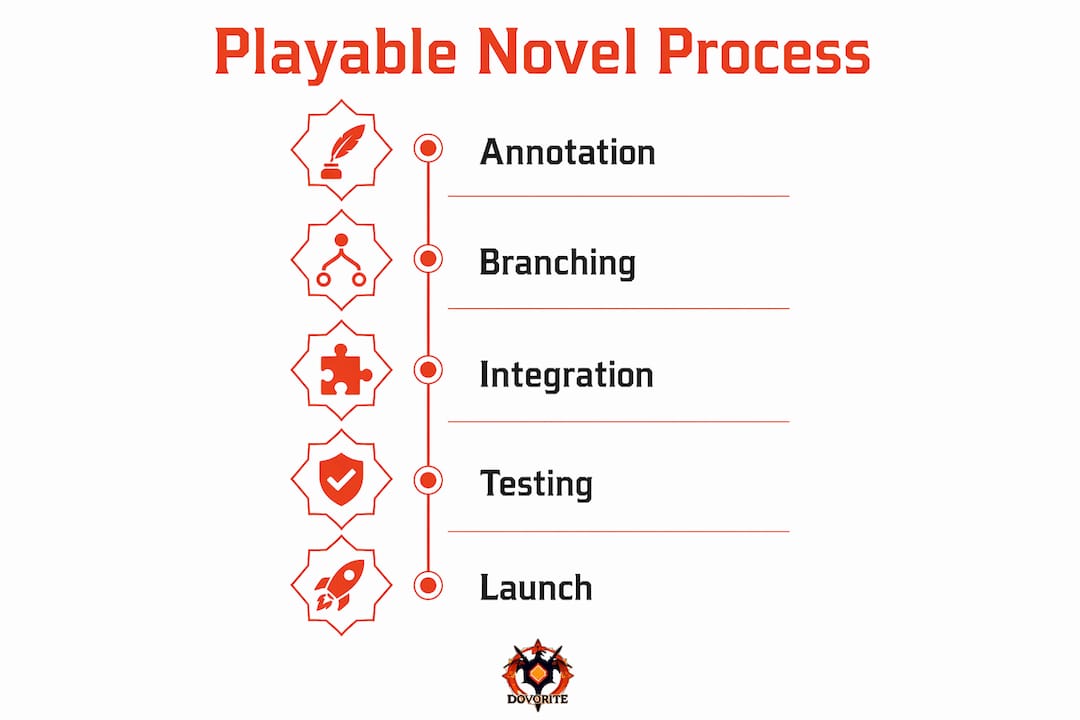
The third building block is visual story mapping. Here is how the development process typically unfolds for a playable novel:
- Annotate the source text. Writers tag every character, rule, and narrative branch using a markup language like NML.
- Map the story visually. Node-based editors on infinite canvases let developers lay out branching paths without writing linear code. Each node represents a scene or decision point.
- Build the narrative engine. The engine reads the annotated text and the node map, then generates responses that stay consistent with the story’s rules.
- Test for fidelity. Writers play through every major branch to confirm that character behavior and plot logic hold across all paths.
- Release episodically. Complex adaptations often ship in chapters, allowing teams to refine later sections based on player feedback.
“Playability relies on converting linear text into structured data with embedded rules and branching points, enabling AI to simulate a coherent, interactive narrative world.” — We built the thing, here’s what it does
Character.ai’s April 2026 “Books” launch demonstrated this pipeline at scale. The platform made 20+ classic titles playable by applying AI-driven narrative parsing to public-domain works. That release proved the technology is mature enough for mainstream deployment, not just experimental prototypes.
Why audiences now prefer interactive storytelling
The cultural appetite for playable novels is not accidental. It reflects how digital-native audiences consume all media. They track stats, share outcomes, debate choices, and build communities around the stories they experience together.
Playable novels generate community discourse in the same way prestige television does. When a show like The Last of Us airs, viewers argue about character decisions for days. Playable novels create that same conversation, except the decisions belong to the reader. Your ending differs from your friend’s ending. That difference is the conversation starter.
Several forces are driving this preference shift:
- Active participation over passive consumption. Audiences want to influence outcomes, not just witness them. The impact of gameplay on reading engagement shows that readers who make choices report stronger emotional investment in characters.
- Emotional stakes through consequence. When a choice you made leads to a character’s death, the grief is sharper than if an author simply wrote that death. You carry partial responsibility. That weight is what makes interactive storytelling memorable.
- Replayability as value. A traditional novel offers one complete experience. A playable novel offers many. For audiences accustomed to content abundance, that depth matters.
The LitRPG market’s 10% annual growth is the clearest evidence of this shift. That rate reflects sustained demand, not a passing trend. Digital natives who grew up with video games and social media expect stories to respond to them. Playable novels meet that expectation directly.
How playable adaptations stay faithful to original novels
Adapting a beloved novel into a playable format carries real risk. Change too much and you lose the story’s soul. Change too little and the interactivity feels bolted on. The best adaptations solve this through deliberate structural choices.
| Approach | Traditional novel | Playable adaptation |
|---|---|---|
| Story structure | Linear, fixed sequence | Branching paths with canonical anchors |
| Reader role | Passive observer | Active co-author |
| Endings | Single authored conclusion | Multiple player-determined outcomes |
| Fidelity method | N/A | Structured annotation and prompt caching |
| Development timeline | Months to write | Multi-year production cycles |
The most proven method for maintaining fidelity is canonical prompt caching. The original text is stored as authoritative data that the narrative engine always references. Player choices can branch the story, but they cannot contradict established facts about the world, the characters, or the rules the author set. This keeps the adaptation recognizable as the source material while still feeling genuinely interactive.
Ken Follett’s The Pillars of the Earth adaptation illustrates the time investment required. The project ran from May 2014 through March 2018 across three episodic releases. That timeline reflects the depth of work needed to honor a complex novel while building a playable structure around it. Shortcuts produce shallow experiences that neither readers nor players respect.
Another effective approach is the alternate universe remix. Rather than replacing the original story, developers create parallel narratives that expand the world without overwriting it. Readers who love the source material can explore new corners of the story without feeling that the original has been compromised.
Pro Tip: When evaluating a playable novel adaptation, check whether it offers a “book arc” mode. This mode follows the original story’s spine and signals that the developers treated fidelity as a priority, not an afterthought.
Key Takeaways
Traditional novels became playable because player agency creates deeper emotional investment than passive reading ever can, and technology now makes that agency structurally possible at scale.
| Point | Details |
|---|---|
| Player agency is the core driver | Readers who make meaningful choices report stronger emotional investment in story outcomes. |
| Technology enables the transformation | Tools like Narrator Markup Language, prompt caching, and node-based editors convert linear prose into interactive systems. |
| Audience demand is measurable | The LitRPG genre grows roughly 10% year-over-year, reflecting sustained preference for agency-driven narratives. |
| Fidelity requires deliberate structure | Canonical prompt caching and structured annotation preserve original story logic across branching paths. |
| Adaptation is a multi-year commitment | High-fidelity projects like The Pillars of the Earth took nearly four years to develop across episodic releases. |
What the playable novel shift means for storytelling’s future
I have spent years watching readers describe books they love, and the language they use is almost always about feeling trapped in a story, unable to put it down. What playable novels do is make that feeling literal. You are not trapped by an author’s choices. You are trapped by your own.
That shift changes the relationship between reader and narrative in ways I find genuinely significant. Traditional novels create empathy by showing you a character’s inner life. Playable novels create empathy by making you responsible for that character’s fate. Those are different cognitive experiences, and the second one is more demanding. It asks more of you, and it gives more back.
The educational potential here is underexplored. A student who plays through a historical fiction adaptation does not just read about consequences. They cause them. That distinction matters for retention and understanding. I expect schools and publishers to recognize this within the next few years, particularly as platforms like Character.ai normalize the format.
The challenge for creators is real, though. Writing a playable novel is not writing one story. It is writing many stories that share a spine. That requires a different skill set than traditional authorship, and the industry is still developing the tools and workflows to support it. The writers who figure out how to craft compelling branching narratives without losing narrative coherence will define this medium for the next decade.
— Corban
Experience playable novels with Dovorite
The evolution from passive reading to active participation is exactly what Dovorite was built for. Dovorite Chronicles puts you inside original fantasy adventure novels where every choice you make shapes the story’s outcome. Strategic dice rolls, branching narratives, and dynamic consequences make each session genuinely different from the last.

Whether you want to forge alliances in The Frost Queen’s Gambit, unravel mysteries in The Cipher of Lost Cities, or build your own saga across multiple titles, Dovorite delivers the depth that literary RPG audiences demand. Explore the full catalog of playable fantasy adventure novels and start writing your own ending today.
FAQ
What makes a novel “playable” rather than just interactive?
A playable novel gives the reader choices that structurally alter the story’s path and ending, not just its tone. Player agency and multiple narrative branches are the defining features that separate playable novels from annotated or hyperlinked texts.
Why did traditional novels start incorporating game mechanics?
Traditional novels became interactive because audiences raised on video games and social media expect stories to respond to their decisions. The LitRPG genre’s consistent growth confirms that this demand is structural, not seasonal.
How do developers keep playable adaptations true to the original book?
Developers use canonical prompt caching and structured annotation to lock the original story’s facts, characters, and rules into the narrative engine. Player choices branch the story without contradicting the source material’s established logic.
What tools are used to build playable novels?
The primary tools include Narrator Markup Language for text annotation, node-based story editors for visual branch mapping, and AI narrative engines that use prompt caching to maintain story consistency at speed.
How long does it take to adapt a novel into a playable format?
High-fidelity adaptations typically require multi-year development cycles. The Pillars of the Earth took nearly four years across three episodic releases, which reflects the complexity of preserving narrative integrity while building a fully branching interactive system.