Decode Text RPG Combat Systems: A Player’s Guide

A text RPG combat system is a structured set of rules governing combat interactions presented through text, combining strategic decision-making with narrative descriptions. If you want to decode text RPG combat system mechanics and turn that knowledge into a real advantage, you need to understand what sits beneath the words on screen. The rules are always there. Most players just never look for them.
Text RPGs from tabletop frameworks like Dungeons and Dragons to modern AI-driven engines like those built on JSON-structured combat stacks all share the same skeleton. Once you see that skeleton, every fight becomes a puzzle you can solve.
What makes up a text RPG combat system?
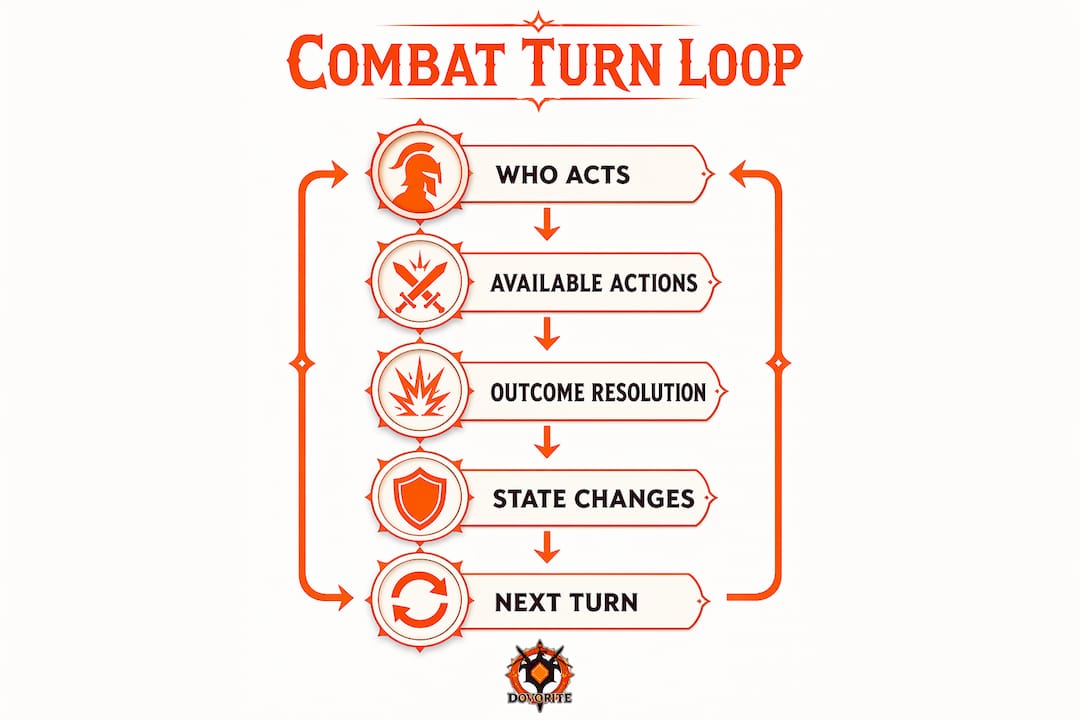
Every text RPG combat system answers four questions on each turn: who acts next, what actions are available, how those actions resolve, and what changes as a result. Turn-based combat loops follow this structure without exception. Understanding this loop is the fastest way to stop reacting and start planning.

Turn order and initiative
Turn order is the spine of any combat system. Most systems determine it through initiative rolls, typically a d20 plus a speed or dexterity modifier. Good turn order design is predictable, influenceable, and communicates upcoming turns clearly. That last point matters more than most players realize. When you can see who acts next, you can plan around it.
Action types and what they do
Actions fall into three broad categories: offensive moves, defensive moves, and utility moves. Offensive actions deal damage using formulas like d8 plus a strength modifier rolled against an armor class. Defensive actions reduce incoming damage or reposition your character. Utility actions apply buffs, debuffs, or status effects that shift the math in your favor over multiple turns.
Pro Tip: Track which actions your enemies use most often. Patterns in enemy behavior reveal the underlying decision logic, which tells you exactly how to counter it.
How outcomes are determined
Mechanical consistency is the core of player trust. Identical situations must produce identical probability ranges. Randomness in well-designed systems is bounded and visible, meaning you always know the minimum and maximum possible outcome before you commit to an action. That predictability is what separates a fair fight from a frustrating one.
Status effects and state changes
Status effects modify the rules temporarily, creating urgency or opportunity beyond raw damage. A “poisoned” state drains health each turn. An “exposed” state lowers your armor class. A “protected” state absorbs incoming hits. These effects are the glue of any deep combat system. They force you to weigh short-term damage against long-term positioning, which is where real strategy lives.
How do different text combat system types compare?
Choosing between turn-based and real-time combat is one of the most foundational decisions in text RPG design. Each approach creates a different player experience and demands a different kind of thinking.
| System type | Core strength | Main challenge | Best for |
|---|---|---|---|
| Turn-based | Strategic depth, planning time | Can feel slow without good pacing | Tabletop fans, tactical players |
| Real-time | Immediacy, reflex-driven tension | Hard to balance in text format | Action-focused players |
| Hybrid | Combines planning with urgency | Complex to design and balance | Experienced players |
| Data-driven modular | Scalable, easy to update | Requires structured authoring tools | Developers and designers |
Turn-based combat gives you time to think. That reflection window is why turn-based systems are generally more accessible and align better with strategic RPG styles. Real-time text combat compresses that window, demanding faster reads of the situation. Hybrid systems try to offer both, though they require careful balancing to avoid feeling like neither.
Data-driven modular systems represent the most flexible approach. Engines that use external JSON files to define enemies, classes, and combat states can support five or more action types and up to eleven status effects without rewriting core logic. That modularity means a single engine can power wildly different game worlds by swapping out data files rather than rebuilding mechanics from scratch.
The right system type depends on what you value. If you want to analyze and master a combat system, turn-based is the clearest to decode. Every decision is visible, every outcome is traceable, and the math never hides behind reaction speed.
How do modern text RPG engines implement combat with AI?
Modern text RPG engines separate two jobs that older systems tried to do at once: resolving the math and telling the story. LLM-based text adventure combat handles initiative rolls and damage calculations mechanically, then feeds those structured results to an AI narrative layer that writes the description. The math stays clean. The story stays immersive.
JSON-driven combat stacks
External JSON files define enemies, player classes, and combat states in modern engines. A single enemy entry might include attack values, defense ratings, available abilities, and a list of status effects it can apply or receive. Authoring tools like buildCombatStack() let designers wire these components together quickly without touching the underlying engine code. That separation makes the system both readable and modifiable.
Pro Tip: If you are playing a text RPG built on structured data, pay attention to how enemy descriptions change when status effects apply. Those narrative shifts often mirror exact mechanical state changes you can track and predict.
Tool-calling and AI fairness
AI-driven combat engines use tool-calling to have language models request dice rolls and inventory checks mid-narration rather than generating outcomes from memory. This prevents the AI from hallucinating results and maintains mechanical fairness. The language model describes the fight. A separate function handles the numbers. Players get immersive text without sacrificing accurate outcomes.
Unified decision layers for enemy AI
Tactical AI opponents use a unified decision layer that scores all available abilities before selecting one. This prevents enemies from spamming the same move repeatedly and creates behavior that feels genuinely tactical. When an enemy consistently targets your weakest status or avoids a move after you apply a specific buff, that is the decision layer working as designed. Recognizing it gives you a direct counter.
Supplying structured combat state data in JSON format to the language model is what prevents inconsistencies like ignored cooldowns or forgotten debuffs. The AI reads the current state, not its own memory. That design choice is why well-built modern text RPGs feel consistent even across long sessions.
What strategies help you decode and win at text RPG combat?
Decoding a text RPG combat system is a skill. It takes deliberate observation, not just repeated play. These steps work across systems from classic tabletop adaptations to AI-powered engines.
-
Map the turn order first. Before you plan any strategy, identify how initiative works. Does it reset each round or persist? Can you modify it with items or abilities? Knowing who acts when is the foundation of every other decision.
-
Catalog every action available to you. List offensive, defensive, and utility options separately. Note the cost of each, whether that is action points, mana, or cooldown turns. Utility actions are almost always underused by new players and overused by experienced ones.
-
Read status effects as math, not flavor. When a status effect applies, ask what number it changes and for how long. “Burning” might mean minus two hit points per turn for three turns. That is six guaranteed damage you can factor into your resource planning.
-
Track enemy patterns across multiple encounters. Enemies in well-designed systems follow decision logic. If a boss always uses its strongest attack when below half health, that is a pattern you can prepare for. Use the combat state tracking tools available in your game to log these observations.
-
Use narrative clues to confirm mechanics. In AI-driven text RPGs, the story description often mirrors the mechanical state. If the text says your enemy looks unsteady, check whether a debuff applied. Narrative and math are linked by design in modern engines.
-
Adapt your tactics to system complexity. A simple system rewards direct aggression. A complex system with many status effects rewards patience and setup. Identify which type you are playing before committing to a style. Understanding text RPG stats deeply accelerates this process.
Key takeaways
Text RPG combat systems reward players who treat mechanics as a puzzle, not a backdrop.
| Point | Details |
|---|---|
| Four-question loop | Every turn answers who acts, what options exist, how they resolve, and what changes. |
| Mechanical consistency | Identical inputs must produce identical probability ranges for the system to feel fair. |
| Status effects as strategy | Debuffs and buffs shift the math over multiple turns, making them more valuable than raw damage. |
| AI separates math from story | Modern engines resolve dice rolls mechanically and feed results to AI for narrative output. |
| Pattern recognition wins fights | Tracking enemy decision logic across encounters reveals predictable counters you can exploit. |
Why transparent mechanics are the real game
Most players treat text RPG combat like a story they are watching. The ones who win treat it like a system they are reading. I have spent years analyzing how combat design choices affect player behavior, and the single biggest gap I see is players ignoring status effects until they are already losing. Status effects are not flavor. They are the most information-dense part of any combat loop, and they telegraph the designer’s intent more clearly than any other mechanic.
The shift to AI-driven engines has made this more interesting, not less. The challenge now is that the math is hidden behind natural language. A well-built engine like those using tool-calling keeps the math honest, but players who do not know to look for it will mistake narrative drama for mechanical randomness. They are not the same thing. When the AI describes your sword glancing off armor, that is a specific number failing a specific check. Knowing that changes how you play.
My honest recommendation for anyone serious about text RPG strategy: play one system long enough to break it. Find the edge cases. Test whether the same action always produces the same range of outcomes. If it does, you have found a system worth mastering. If it does not, you are dealing with inconsistent design, and no amount of strategy will fully compensate for that.
— Corban
Text RPG combat comes alive on Dovorite Chronicles
Dovorite Chronicles puts you inside playable fantasy adventure novels where every combat choice carries real weight. The platform uses AI-driven turn-based mechanics that separate dice resolution from narrative generation, so fights feel both fair and immersive.

Whether you want to test your decoding skills against tactical enemies or experience story-driven combat with genuine strategic depth, Dovorite has an adventure built for it. Titles like The Last Dragon’s Hoard and The Cipher of Lost Cities feature layered combat systems designed for players who want to think, not just click. Start your saga at Dovorite Chronicles and put these mechanics to work.
FAQ
What is a text RPG combat system?
A text RPG combat system is a structured ruleset governing combat interactions through written descriptions, combining dice-based resolution, turn order, and status effects to create strategic gameplay.
How does turn-based text RPG combat work?
Turn-based text RPG combat follows a loop: determine who acts, present available actions, resolve outcomes with dice or formulas, and apply state changes before the next turn begins.
What are the main types of text-based combat systems?
The three main types are turn-based, real-time, and hybrid. Turn-based systems offer the most strategic depth and are the easiest to decode and analyze.
How do AI-powered text RPGs keep combat fair?
AI-powered engines use tool-calling to invoke dice rolls and inventory checks as separate functions during narration, preventing the language model from generating outcomes from memory and ensuring mechanical accuracy.
How can I get better at text RPG combat?
Track turn order, catalog every available action, read status effects as math rather than description, and observe enemy patterns across multiple encounters to identify predictable decision logic.