
What Is an Open World Text Adventure?

An open world text adventure is an interactive fiction game where players explore a text-described world non-linearly, with the freedom to revisit locations and shape an ongoing game state through every command they type. Unlike a standard choose-your-own-adventure book, this format treats the game world as a persistent, explorable space where your past choices leave real marks. Classic examples include the Fabled Lands gamebook series, the AI-driven platform AI Dungeon, and experimental projects like Infinite Zork. These titles define what is an open world text adventure in practice: a living, text-based world that responds to you rather than simply moving you forward on a fixed track.
What is an open world text adventure, really?
An open world text adventure is defined by three core features: free spatial exploration, persistent game state, and player-driven consequences. You are not locked into a single story path. You can walk north, double back south, revisit a town you left three sessions ago, and find it changed by what you did before.
Open world gamebooks emphasize revisiting locations with persistent narratives rather than linear story progression. That distinction matters because it shifts the design burden from scripting a plot to simulating a world. The game must remember what you did, not just where you are.

The term “interactive fiction” is the recognized industry label for this broader category. “Open world text adventure” describes a specific subset where spatial freedom and state persistence are the defining mechanics. Both terms are worth knowing. One tells you the medium; the other tells you the structure.
Named examples anchor the concept quickly. Fabled Lands by Dave Morris and Jamie Thomson gave readers a gamebook world with six volumes and hundreds of revisitable locations. AI Dungeon, launched in 2019, brought large language model generation to the format. Infinite Zork extended the classic Zork parser tradition into procedurally generated territory. Each represents a different technical approach to the same core promise: a world you can actually explore.
How do open world text adventures differ from linear ones?
Classic text adventures are mostly linear, puzzle-centric, and built around a single correct path. Open world text games break that structure by design.
In a traditional parser game like the original Zork, players type commands such as “go north” or “take lantern” and receive text responses from an internal world model. The world model is fixed. Puzzles have one solution. The story has one ending. That structure rewards careful reading and logical deduction, but it does not reward wandering.
Open world design rewards wandering. You can pursue a side quest, ignore the main plot for hours, and return to find the world has moved on without you. Consequence is spatial and temporal, not just logical.
| Feature | Linear Text Adventure | Open World Text Adventure |
|---|---|---|
| Story path | Single, fixed sequence | Non-linear, player-directed |
| Location revisits | Rare or blocked | Core mechanic |
| Game state | Minimal, puzzle-based | Persistent, consequence-driven |
| Player freedom | Constrained by puzzle gates | Broad, with meaningful detours |
| Examples | Zork, Hitchhiker’s Guide | Fabled Lands, AI Dungeon |
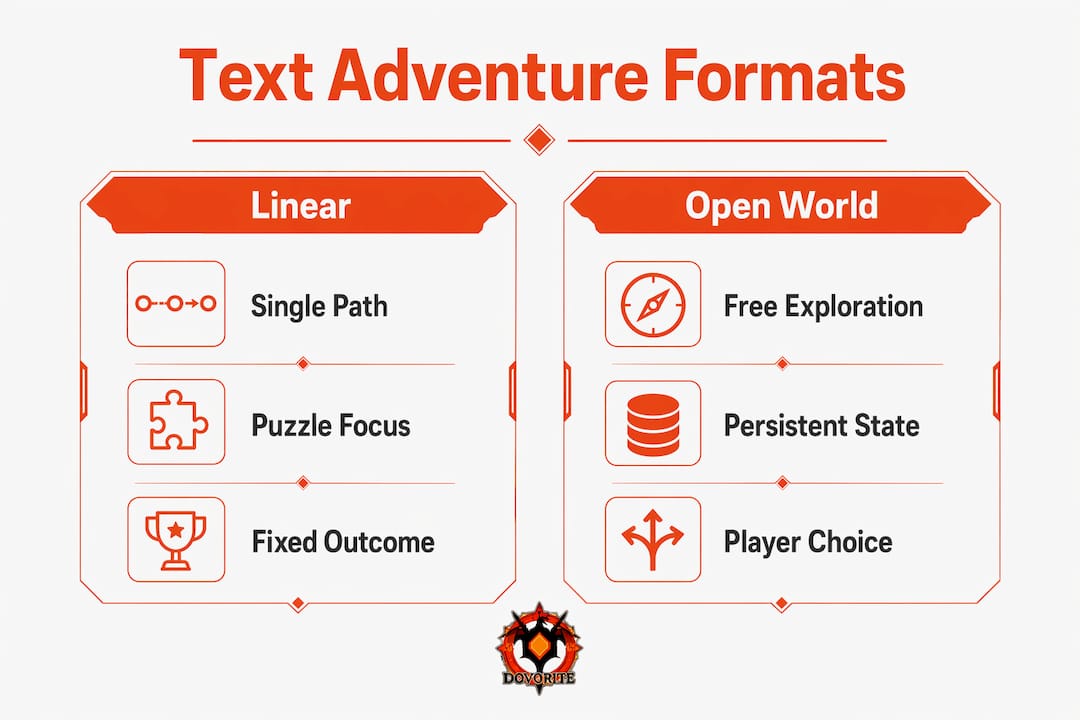
The table above shows the structural gap. Linear adventures gate progress behind puzzles. Open world adventures gate progress behind player choice and world state. That is a fundamentally different contract with the reader.
Classic interactive fiction treats player input as intention with real consequence affecting the underlying game state. That philosophy is what separates genuine open world interactivity from cosmetic branching, where choices feel meaningful but ultimately converge on the same outcome.
What are the mechanics behind open world text games?
The mechanics of open world text adventures are, at their core, a state management problem. The game must track where you are, what you have done, who you have met, and what has changed as a result.
Routing mechanisms using current location counters and tickboxes enable complex quest progression and multi-stage NPC interactions in open world interactive fiction. In practice, this means the game stores a “Current Location” value and a set of flags. When you complete a subquest in the eastern forest, a flag flips. When you return to the capital city, the game reads that flag and changes what the merchant says to you.
The key design challenges break down into four areas:
- State coherence: Every player action must update the world model correctly. A missed flag means a character who acts like they never met you, even after a major shared event.
- Quest routing: Players wander. The game must handle detours gracefully without breaking the main narrative thread or stranding the player in an unwinnable state.
- Feedback loops: Open world text adventures demand effective feedback systems to avoid player aimlessness and sustain engagement. Without clear signals, players get lost and disengage.
- Parser precision: Text input is unforgiving. A player who types “grab torch” instead of “take torch” should not hit a dead end. Good parser design anticipates synonyms and natural language variation.
Pro Tip: Build your state management layer before you write a single line of narrative. Knowing exactly what the world tracks makes every story beat more reliable and every player choice feel genuinely consequential.
Effective open world design treats the world as stable facts independent of narrative flow. The story can be flexible. The facts cannot. That separation is what keeps a large, branching world from collapsing into contradiction.
How do AI and procedural generation change the format?
AI and procedural generation are the most significant shift in open world text adventure design since the parser itself. They change what “world” means in this context.
Two main approaches exist. Pre-generation builds the entire world before play begins, then lets players explore it. Turn-by-turn generation creates new content as the player moves through the world. Both approaches carry tradeoffs: pre-generation controls cost and consistency; on-demand generation enables infinite worlds but risks incoherence.
Infinite Zork demonstrates the procedural approach directly. It uses large language models to extend the classic Zork world beyond its original boundaries, generating new rooms, objects, and descriptions as you explore. The world feels endless. The risk is that it also feels arbitrary without careful state management layered underneath the generation.
AI Dungeon takes a different path. It uses LLM generation turn by turn, which means the world grows with your input. The benefit is genuine surprise. The cost is session-based play without long-term world history, which means the world often forgets what happened three sessions ago. That is the core tension between AI-generated adventures and persistent multiplayer text RPGs like those on Iron Realms Entertainment, where worlds have run continuously for years.
Pro Tip: If you are building an AI-driven text adventure, separate your world facts from your narrative generation. Let the LLM write the prose, but keep location data, NPC states, and quest flags in a structured database the model reads from. This prevents the drift that makes AI worlds feel unreliable.
LLM narration alone can drift. World state must be managed separately for consistency. That insight from practitioners in the field is the single most important lesson for anyone building or evaluating AI-driven open world text games today.
The world simulation layer underneath the prose is what separates a genuinely open world experience from a very convincing illusion of one.
What are the best examples of open world text adventures?
The best examples of open world text adventures span four decades and multiple technical approaches. Each one illustrates a different solution to the same design challenge.
Fabled Lands (1995, Dave Morris and Jamie Thomson): A six-volume gamebook series where each book is a region of a shared world. You carry a single character sheet across all volumes. Actions in one book affect what is available in another. This is persistent state across physical books, which was a remarkable design achievement for its era.
AI Dungeon (2019, Latitude): The first widely accessible LLM-driven text adventure. You describe any action and the game responds. The world is theoretically infinite. The tradeoff is consistency, since the model can contradict earlier events without a strong state management layer.
Infinite Zork (experimental, open source): A research and hobbyist project that extends the original Zork world using procedural LLM generation. It demonstrates how classic parser traditions can scale into open world territory with modern tools.
MUDs (Multi-User Dungeons): Platforms like those hosted by Iron Realms Entertainment run persistent text worlds measured in years, not sessions. MUDs rely on reading and language precision while MMOs use visual scanning and spatial skills. That difference makes MUDs a distinct cognitive experience. You can explore multiplayer text adventures across several active platforms today.
For readers interested in the structural differences between these formats, the distinction between a text adventure and a text RPG is worth understanding before you commit to one over the other.
Key takeaways
An open world text adventure is defined by persistent state, revisitable locations, and player-driven consequences, not just by the absence of a fixed story path.
| Point | Details |
|---|---|
| Core definition | Free exploration plus persistent state separates open world text adventures from linear interactive fiction. |
| State management is foundational | Tracking location flags and quest states is the technical backbone of any open world text game. |
| AI generation adds scale, not stability | LLM-driven worlds grow infinitely but require a separate state layer to stay coherent across sessions. |
| Classic examples still teach best | Fabled Lands and Zork demonstrate state persistence and parser design principles that modern tools still rely on. |
| Feedback systems prevent aimlessness | Players need clear signals about consequence and progress, or spatial freedom becomes disorienting rather than engaging. |
Why open world text adventures still demand more than we give them
I have spent years reading, playing, and writing about interactive fiction, and the format that consistently humbles me is the open world text adventure. Not because it is technically complex, though it is. Because it asks something most game designers underestimate: the world has to be true.
When you play a graphical open world game, visual detail covers a lot of inconsistency. A misplaced NPC is easy to overlook when the sunset looks stunning. In a text adventure, there is nowhere to hide. If the blacksmith remembers your name in chapter two but forgets your entire history in chapter five, the illusion collapses completely. The reader notices every seam.
What I find most interesting about the current AI-driven wave is that it has exposed this problem at scale. AI Dungeon proved that players want infinite worlds. It also proved that infinite worlds without stable facts feel hollow after a few sessions. The most promising work I see now treats the LLM as a prose writer and the state engine as the author of record. That division of labor is the right instinct.
The classic Fabled Lands books solved this with index cards and section numbers. Modern builders solve it with databases and vector stores. The underlying principle has not changed in 30 years: the world must remember you, or none of it matters.
If you are new to the format, start with Fabled Lands or a MUD before you touch AI Dungeon. Understanding what a well-managed persistent world feels like makes every other format easier to evaluate. The text RPG quest structure that underlies these games is worth studying even if you never plan to build one yourself.
— Corban
Experience open world storytelling on Dovorite
If the mechanics of open world text adventures have you ready to play rather than just read about them, Dovorite Chronicles is built exactly for that. Dovorite blends authored narrative with AI-driven choices, so every session produces a story that is genuinely yours. Strategic dice rolls, branching consequences, and a world that responds to your decisions put you inside the fiction rather than in front of it.

Titles like The Shadow Market, Fairy Shenanigans, and The Last Dragon’s Hoard each offer a distinct world with real stakes and persistent player choices. Start your first adventure through the Dovorite affiliate page and see what it feels like when the story actually listens.
FAQ
What is a text adventure game?
A text adventure is an interactive fiction game where players read text descriptions of a world and type commands to interact with it. The game responds to input by updating the world state and delivering new text output.
How does an open world text adventure differ from a choose-your-own-adventure?
A choose-your-own-adventure presents fixed branching paths with predetermined outcomes. An open world text adventure tracks persistent state across a freely explorable world, meaning player choices have lasting consequences rather than just selecting the next page.
Can AI generate a full open world text adventure?
AI can generate the prose and expand world content dynamically, but coherent open world play requires a separate state management layer. Without it, AI-generated worlds tend to contradict themselves across sessions.
What are the best open world text games for beginners?
Fabled Lands is the most accessible introduction to persistent open world gamebook design. AI Dungeon offers a low-barrier entry point for players who want AI-driven narrative freedom without learning parser commands.
How do you create an open world text adventure?
Start by designing your state management system before writing any narrative. Define what the world tracks, such as location, NPC states, and quest flags, then build your prose layer on top of that stable foundation.