
Why Playable Novels Use Choice Systems to Engage You

Choice systems in playable novels are the core mechanic that transforms reading from a passive act into an authored experience. Instead of following a fixed path, you shape the story’s direction through decisions that carry real consequences. This is why playable novels use choice systems: they give you ownership of the narrative. Platforms like Dovorite and titles like Mass Effect have proven that when readers become co-authors, emotional investment rises sharply. Cognitive psychology research and game design theory, including frameworks developed by scholars like Jesper Juul, confirm that meaningful choice is the engine behind interactive storytelling’s unique power.
Why do playable novels use choice systems for player agency?
Player agency creates genuine emotional stakes by making you a co-author rather than a spectator. When a character dies because of your decision, you feel grief. When your alliance wins because you chose wisely, you feel achievement. That emotional weight does not come from identification with a character. It comes from authorship of the outcome.
Choice systems also force characters into “best bad choice” dilemmas. These are situations where every option carries a cost. Fewer impactful options reduce player anxiety and generate sharper narrative tension than sprawling menus of trivial decisions. A choice between saving one ally or protecting a village hits harder than picking a dialogue tone from six options.

The psychological effect is deliberate. Cognitive biases like loss aversion and the sunk cost fallacy shape how you weigh options inside a story. Designers who understand these biases build choices that feel weighty without feeling unfair.
Pro Tip: When you notice a choice that makes you pause and reconsider, that is the designer doing their job correctly. That hesitation is narrative tension made physical.
The key benefits of strong player agency in playable novels include:
- Personal investment in story outcomes because your decisions caused them
- Emotional depth tied to consequences, not just plot events
- A sense of authorship that linear novels cannot replicate
- Replay motivation driven by curiosity about unchosen paths
What narrative design challenges underpin effective choice systems?
Designing a branching story is far more complex than writing a linear novel. Revising branching storylines can take weeks because removing one character may require replotting half the story graph to maintain consistency. Every scene connects to states, variables, and prior decisions. One change ripples outward.
Designers manage this complexity through visual graph editors. These tools represent scenes as nodes and choices as edges, while tracking state variables like reputation, health, or relationship scores. Visual graph editors let teams see the full shape of a narrative at once, catching broken branches before they reach players.
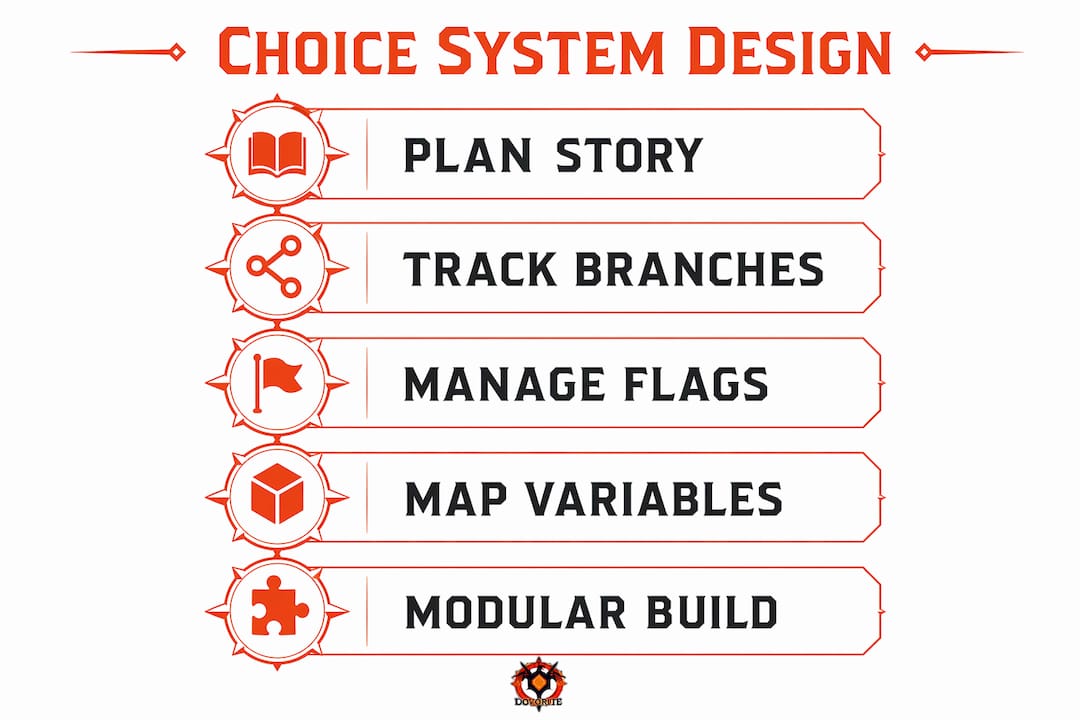
| Design challenge | Solution used |
|---|---|
| Tracking branching scenes | Visual story graph editors with node-based layouts |
| Managing narrative state | Hidden flags and relationship point accumulators |
| Scaling content volume | Modular storylet architectures |
| Maintaining consistency | State variable tracking across all branches |
Hidden flags are one of the most powerful tools in this process. Choices early in the story may not trigger immediate changes but influence outcomes chapters later. A small act of kindness in chapter two might unlock a rescue in chapter nine. Players rarely see the flag set. They only feel the consequence.
Pro Tip: If you are designing a choice system, map your flags and relationship variables in a spreadsheet before writing a single scene. Retrofitting state logic into finished prose is far harder than planning it upfront.
Modular and procedural storylet architectures take this further. Instead of one giant branching tree, the story is built from self-contained scenes that activate based on accumulated player state. Adaptive storylet architectures scale replayability without requiring exponentially more content for each new branch.
How do choice systems balance player freedom with authorial control?
The tension between player freedom and authorial intent is the defining design problem of interactive fiction. Simulated freedom is the solution most effective designers reach: players perceive meaningful control within a carefully constrained space. The aesthetic focus is the tension itself, not the number of options available.
Infinite choice is not the goal. A story where every decision is equally valid produces narrative chaos. The author’s job is to make constraints feel invisible. You should feel free even when the path is narrower than it appears.
The most effective approach to balancing freedom and control involves:
- Designing choices that reflect character values, not just plot mechanics
- Delaying consequences so players feel the weight of past decisions later
- Using moral dilemmas as narrative laboratories where ethical tension slows down rather than resolves quickly
- Ensuring every major choice has a visible, story-changing consequence
The Gilliam Writers Group frames this well: novelists should treat stories as moral choice laboratories where weighty consequences are dramatized rather than resolved quickly. That principle applies directly to playable novel design. Tension held longer creates more memorable outcomes than tension released fast.
Successful choice systems also personalize experiences by responding to player history and traits. A Dungeon Master tailoring a campaign to a specific player is the closest analog. The story bends toward who you are, not just what you pick.
What practical benefits do choice systems bring to replayability?
Branching paths directly increase how long players stay engaged with a story. Meaningful branching produces significant increases in user engagement compared to linear formats. Players return not because the prose changes but because the outcomes do.
The comparison between linear and choice-driven novels makes this clear:
| Feature | Linear novel | Choice-driven novel |
|---|---|---|
| Narrative path | Fixed, single route | Multiple branches and endings |
| Emotional ownership | Identification with character | Authorship of outcome |
| Replayability | Low, story is known after one read | High, alternate paths reward return visits |
| Engagement depth | Passive absorption | Active decision-making under tension |
| Personalization | None | Responsive to player history and choices |
Accrued consequences add another layer. Because hidden flags accumulate silently, a second playthrough reveals story layers invisible on the first run. You notice the foreshadowing you missed. You see how your early choices shaped the ending. That discovery loop is what keeps players inside a story long after the credits roll.
For designers, the practical benefit is content longevity. A well-built choice system multiplies the effective story length without requiring proportionally more writing. Dovorite applies this principle directly, building modular puzzle systems that layer onto choice mechanics to deepen each playthrough. The result is a story that feels different on every run, not just superficially but structurally.
Pro Tip: To maximize replayability, design at least one major choice per act whose full consequence only becomes visible two acts later. That delayed payoff is what pulls players back for a second run.
Strong text RPG writing practices reinforce these mechanics by ensuring the prose itself responds to player state. A character who remembers your past betrayal speaks differently than one who trusts you. That responsiveness is what separates a true playable novel from a story with buttons.
Key Takeaways
Choice systems are the defining mechanic of playable novels because they convert reading into authorship, creating emotional stakes, narrative tension, and replayability that linear fiction cannot match.
| Point | Details |
|---|---|
| Agency drives emotional depth | Players feel grief and achievement tied to their own decisions, not passive observation. |
| Fewer choices hit harder | Limiting options to impactful dilemmas reduces anxiety and sharpens narrative tension. |
| Hidden flags shape late outcomes | Early choices accumulate silently and determine endings chapters later. |
| Simulated freedom is the design goal | Constrained but meaningful decisions create the perception of full agency. |
| Branching paths increase replayability | Alternate storylines and delayed consequences reward multiple playthroughs. |
The design mistake most interactive writers make
Most designers I have studied focus too much on the number of choices and not enough on the weight of each one. They build menus. They do not build dilemmas. The result is a story that feels interactive on the surface but hollow underneath. Players click through options without ever feeling the cost of a decision.
The fix is not fewer choices across the board. The fix is consequence clarity. Every major choice needs a visible, story-altering result. Players should be able to trace a line from their decision to the outcome. When that line is invisible or absent, the choice feels decorative.
I have also seen designers underestimate how much iterative testing matters. A choice that feels weighty to the writer often feels obvious to the player. Real players make decisions faster, with less context, and with different values than the author assumed. Testing with actual readers reveals those gaps before they become published problems.
The best interactive stories I have encountered treat tension as an object to be held, not a problem to be solved. They slow down moral dilemmas. They let you sit with a bad choice before the consequence arrives. That delay is where the emotional power lives. Platforms like Dovorite that build dice mechanics and dynamic state tracking into their systems are working toward exactly that kind of sustained tension.
— Corban
Experience choice-driven storytelling with Dovorite
Dovorite Chronicles puts every mechanic described in this article into practice. Each story uses branching paths, hidden flags, and strategic dice rolls to build a saga that responds to your decisions across every session.

The platform’s playable fantasy adventures are built for readers who want more than a fixed narrative. Stories like The Iron Pact use advanced choice mechanics to create moral dilemmas with real consequences and multiple endings. If you want to understand why choice systems work, the fastest way is to play one. Dovorite is where that experience starts.
FAQ
What is a choice system in a playable novel?
A choice system is a mechanic that lets readers make decisions that alter the story’s direction, characters, and outcomes. It transforms reading from passive absorption into active authorship.
How do choice systems increase replayability?
Branching paths and hidden flags create alternate storylines and delayed consequences that reward multiple playthroughs. Players return to discover outcomes they missed the first time.
What is the difference between simulated freedom and infinite choice?
Simulated freedom gives players meaningful decisions within a constrained narrative space. Infinite choice produces chaos. The goal is the perception of full agency, not an unlimited option set.
Why do designers use hidden flags in playable novels?
Hidden flags let early choices shape late outcomes without telegraphing the connection. This creates a sense of narrative depth and rewards attentive players on repeat runs.
How does player agency differ from character identification in linear novels?
In linear novels, readers identify with a character. In playable novels, players author outcomes. That authorship creates emotional stakes tied to personal decisions, not just plot events.